
译者按:
本篇股东信中,巴菲特再次阐述了业绩比较的基准,并深入的分析了合伙企业的三类投资(套利、普通股、控股)。在此基础上,延伸出关于投资是否保守、资金规模限制等话题。
在预测部分,巴菲特也谈到牛市回调的必然,以及大行情出现的顺序、时点的不可知。对应24、25年的当下行情,或有启发。
中译:
1961 Letter
BUFFETT PARTNERSHIP, LTD.
810 KIEWIT PLAZA
OMAHA 31, NEBRASKA
January 24, 1962
1961年业绩
我一直和合伙人们说,我对业绩的期望和希望(两者总是难以区分)是在市场下跌或横盘时,我们的表现比大盘好些,但在市场上涨时,我们的表现可能不那么出色。在大牛市中,我预计要跟上大盘很困难。
尽管1961年整体市场表现非常好,而且对我们来说无论是绝对收益还是相对收益都是非常好的一年,但上述预期不变。
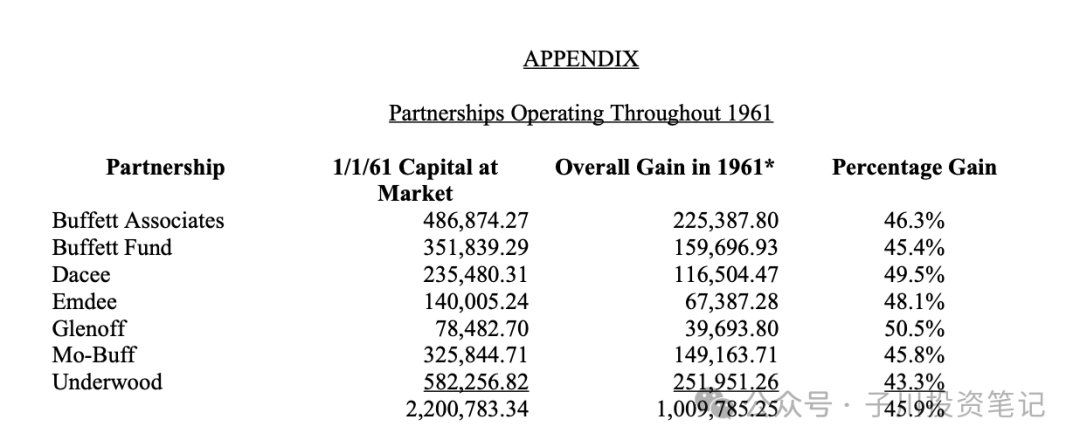
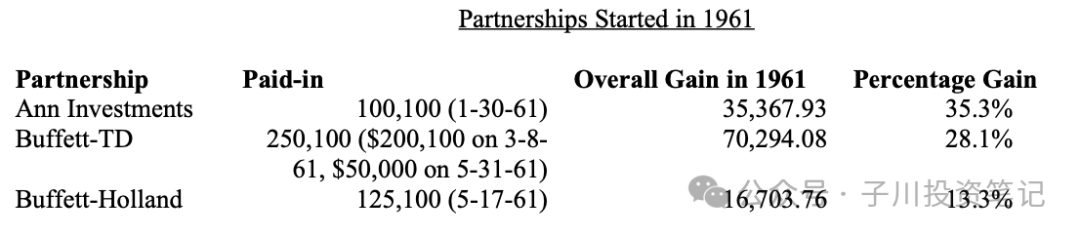
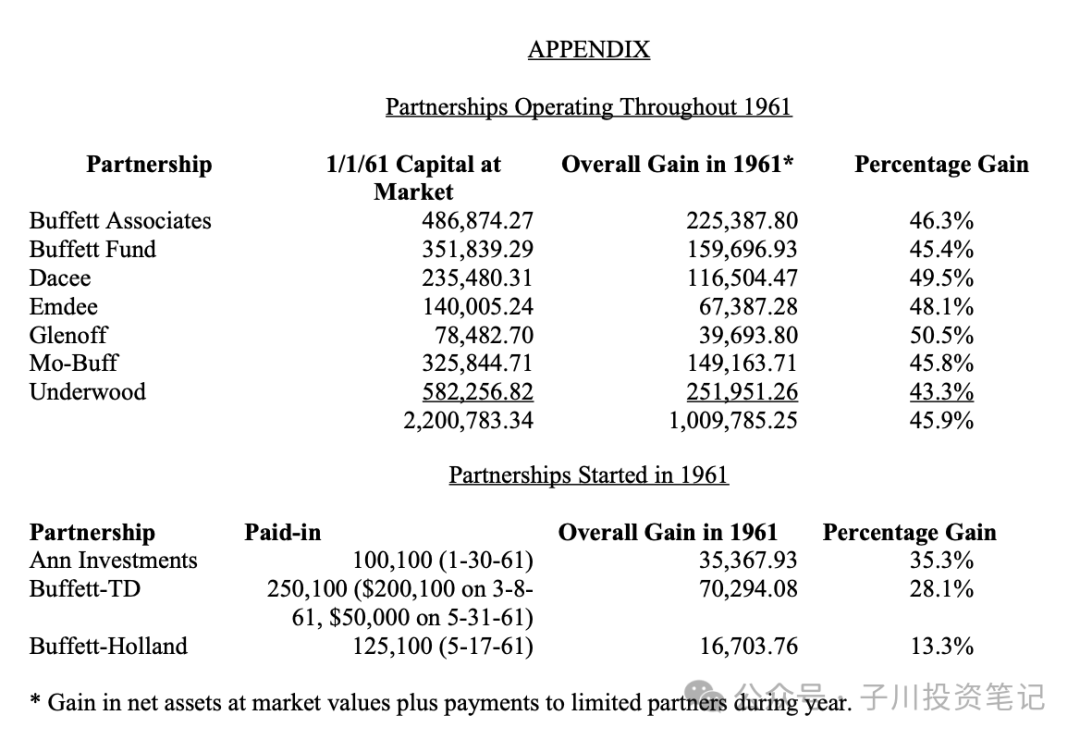
1961年,以道琼斯工业平均指数(以下简称"道指")衡量整体市场,含股息总体收益为22.2%。扣除运营开支后,全年运营的所有合伙企业平均收益为45.9%(尚未做有限合伙人和普通合伙人收益分配)。各合伙企业的具体收益详情及年内新成立合伙企业的业绩见附录。
我们的合伙企业已运营满五年,这五年的业绩以年度和累计(复合)数据方式列示。这些数据的计算基础如上段所述:已扣除费用,但尚未进行合伙人之间的收益分配或支付。
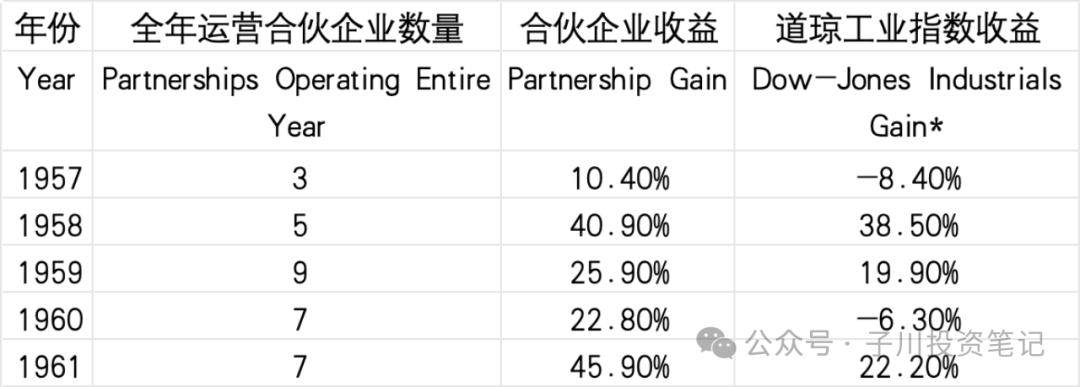
*包括通过持有道指成分股获得的股息。
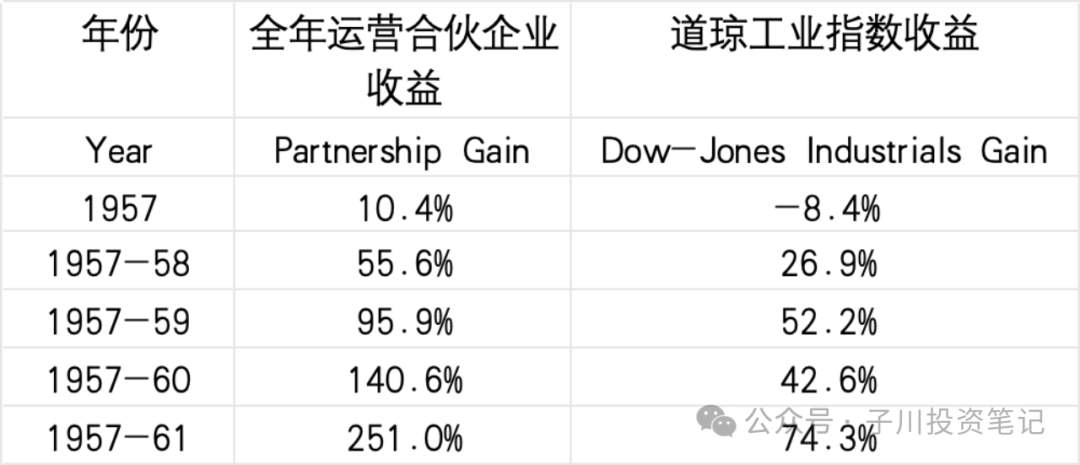
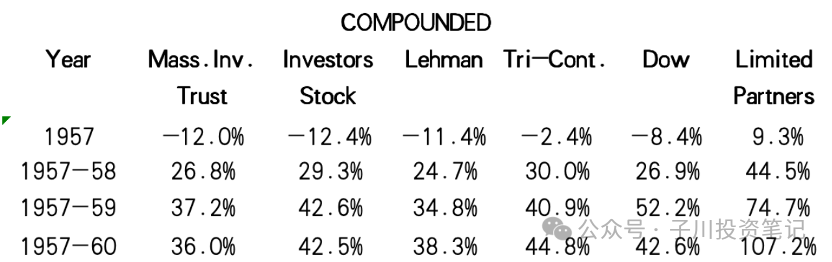
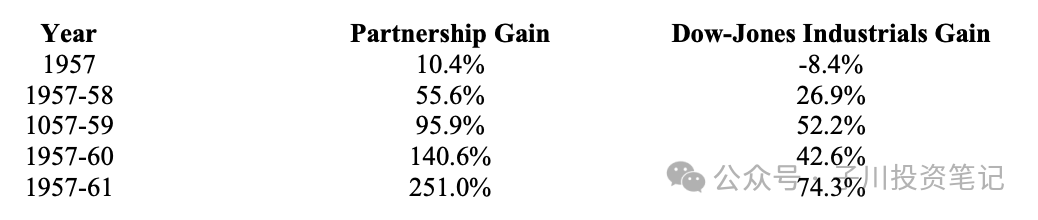
按复合计算,累计业绩如下:
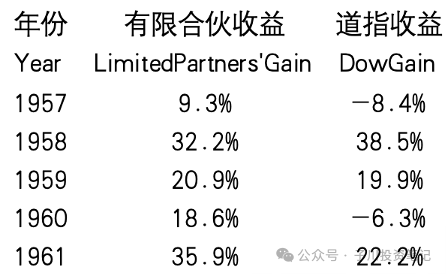
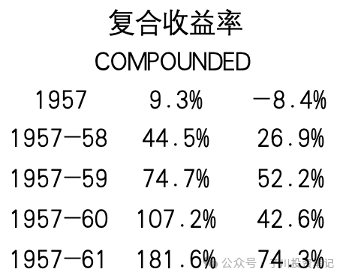
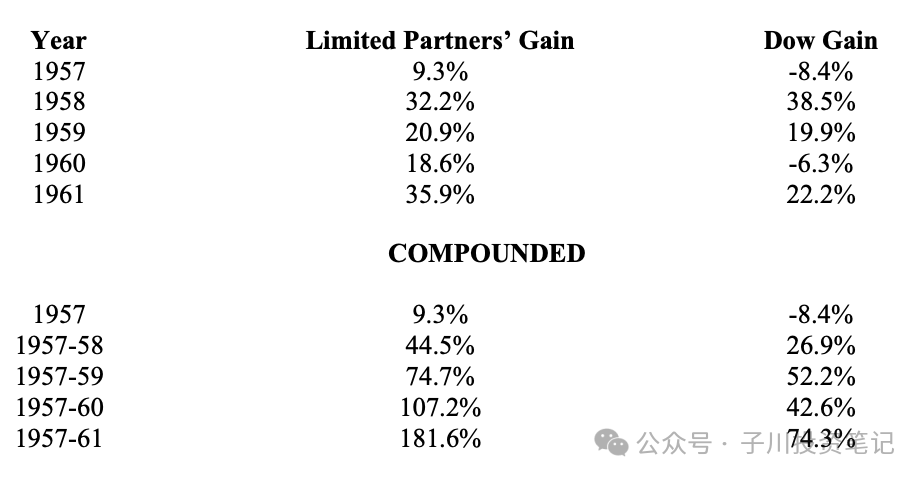
这些业绩数据并未反映有限合伙人的实际收益,而那显然是你们最关心的数字。由于过去存在不同合伙协议安排,我使用了合伙企业的整体净收益(基于年初和年末的市场价值)作为衡量整体表现的最公平指标。按照现行巴菲特合伙有限公司协议中的收益分配方式调整后,历年业绩如下:
关于基准的说明
在选择和维系合伙人关系时,最重要的是确保我们有相同衡量标准。如果我的表现不佳,我希望合伙人退出,事实上,我也会为自己的资金寻找新的投资途径。如果我的表现良好,那就证明我做的很出色-这种“困境”我想我还是能忍受的。
关键在于确保我们对"好"与"差"的理解相同。我认为应事先确立衡量标准;因为如果事后看,任何事情都能找到让它显得不错的参照物。
我一直用道琼斯工业平均指数作为我们的基准。我认为检验业绩至少需要三年时间,最理想的检验是在不短于三年期里,期末道指与期初基本持平。
(译者注:巴菲特是想说,最好的业绩检验应该在一个相对平稳的市场环境中(期初、期末水平接近),这样更能反映出投资管理人的真实能力,而不是依靠整体市场的上涨。)
虽然道指作为业绩衡量标准并不完美(没什么是完美的),但它具有广为人知、存续时间长、能合理反映投资者在市场上的普遍经验等优势。我不反对使用其他衡量整体市场表现的方法,比如其他股票市场指数、主要的多元化股票型共同基金、银行共同信托基金等。
你可能觉得我设立的标准过低,因为要超越一个由30只龙头普通股组成的非主动管理指数似乎很容易。但实际上,这个指数被证明通常是个相当强劲的对手。Arthur Wiesenberger关于投资公司的经典著作列出了所有主要共同基金在1946-1960年15年间的业绩。目前共同基金投资规模超200亿美元,因此这些基金的经验总体上代表了数百万投资者的经验。虽然无法获得确切数据,但我认为大多数领先投资顾问机构和银行信托部门的投资组合取得了与这些共同基金类似的业绩。
(译者注:Arthur Wiesenberger是美国投资研究领域的先驱者。他在1941年创立了Wiesenberger Investment Companies Service,这是第一个专门研究和分析共同基金的服务机构。他的"Investment Companies"(《投资公司》),从1941年开始每年出版,被广泛认为是共同基金行业的权威参考资料。该书详细记录了共同基金的表现、投资策略和统计数据,在20世纪中后期对投资界产生了重要影响。
巴菲特1961年的这封信提到的就是这本年度投资指南,他用其中的数据来说明即使是专业管理的共同基金,大多数也无法持续跑赢道琼斯工业指数。现在这个服务已经被汤森路透收购,并整合到了其金融数据服务中。)
Wiesenberger在其"图表与统计"中列出了70只自1946年以来持续运作的基金。我排除了其中32只基金,原因包括它们是平衡型基金(因此未完全参与整体市场上涨)、专业行业基金等。在被排除的32只基金中,31只表现比道指差,所以这种排除显然不是为了影响下面的结论。
在剩下的38只我认为适合与道指进行比较的共同基金中,32只表现不如道指,6只表现更好。截至1960年底,表现更好的6只基金资产规模约10亿美元,表现较差的32只基金资产规模约65亿美元。这6只表现优于道指的基金,每年的超额收益都不超过几个百分点。下面我列出了我们运营期间的年度业绩对比(不包括1961年,因为我没有确切数据,不过粗略数据显示与1957-60年的情况没有差异),对比对象是两只最大的开放式普通股共同基金和两只最大的封闭式投资公司:
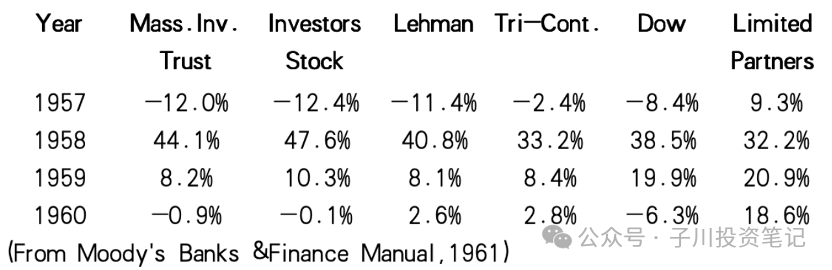
麻省投资信托的净资产约18亿美元;投资者股票基金约10亿美元;三大陆公司约5亿美元;雷曼公司约3.5亿美元;总计超过35亿美元。
我列出上述统计数据和信息,并非是要揶揄这些投资公司。如果让我来投资这么大规模的资金,还要受制于各种投资限制,我的表现可能还不如他们,即便能做到和他们一样好就不错了。我列出这些数据是为了说明,道指作为投资对手并不好对付,而且国内大多数投资基金都会发现要超越甚至仅仅是跟上道指的表现都很困难。
我们的投资组合与道指有很大不同,我们的运作方式也与共同基金有实质性的区别。
然而,对大多数合伙人来说,如果不投资我们的合伙企业,他们的资金可能就会投资在那些与道指产生相似回报的投资渠道中,因此,我认为用道指作为业绩检验标准是公平的。
我们的运作方法
我们的投资分三类,它们的运作特征各有不同,在任何特定年份,我们的资金在三者之间的分配比例,都会显著影响我们相对于道指的表现。实际分配到每个类别的百分比在某程度上是计划过的,但更大程度上是出于偶然,取决于我们有什么投资机会。
第一类是普遍低估的证券(以下称为"普通股"),在这类投资中我们对被投公司的政策没有发言权,也无法预测其价值低估何时会得到纠正。多年来,这一直是我们最大的投资类别,在这里赚到的钱比其他两类都多。我们通常在五六个普通股投资标的上持有相当大的仓位(每个占总资产的5%到10%),在另外十到十五个标的上持有较小仓位。
(译者注:关注被低估的证券。被动持股,不参与经营、 依靠企业自身和市场来实现价值回归;不预测具体的价值实现时间)
有时这些投资很快见效,但通常需要等上几年。在购买时很难知道它们会因为什么具体原因而升值。然而,正是因为缺乏吸引力,也没有任何可能触发即时市场反应的因素,才能以非常便宜的价格买到这些股票。能用如此低价获得大量价值。这种实质性的超额价值为每笔交易创造了舒适的安全边际。每项独立投资的安全边际,再加上多样性投资,创造了一个在安全性和增值潜力两方面都极具吸引力的组合。多年来,我们的买入时机比卖出时机都要好得多。我们投资这些普通股时,并不指望赚到最后一分钱,只要市场价格涨到购买价格与企业私有者估值之间的某个水平,我们就会满意地退出。
(译者注:[1] "private owner"(私有者)是格雷厄姆-多德投资体系中的重要概念,指完整拥有并经营企业的个人或实体。与在公开市场上的众多股东不同,私营业主同时拥有所有权和经营权,能完全按照自己的意愿来经营企业,不受市场短期波动和外部股东的影响。巴菲特用这个概念作为估值参考,意在从企业实际经营者的角度来判断企业的合理价值,而不是依赖市场的短期定价。)
普通股的市场表现常常与道指同步。仅凭某个东西价格便宜并不意味着它不会下跌。在市场急剧下跌时,这部分投资的可能跌幅与道指相当。但我相信长远来看,普通股投资的表现会好过道指,在像1961年这样市场大幅上涨的年份,这部分投资会带来最好的业绩。当然,这部分投资也是在市场下跌时最容易受伤的部分。
我们的第二类投资是"套利"。这类证券的收益取决于被投企业的公司行为,而不是证券买卖双方创造的供需因素。换句话说,这些是有时间表的标的物,我们可以在合理误差范围内预测,什么时候能得到多少,以及什么时候计划可能被破坏。并购、清算、重组、分拆等公司事件都会带来套利机会。近年来,石油生产商向大型综合性石油公司的出售也是重要来源。
这类投资每年会产生相当稳定的收益,在很大程度上不受道指走势的影响。显然,如果我们某年有很大部分投资组合都在“套利”交易上,那么如果当年道指下跌,我们的业绩看起来就会极出色,如果道指当年强势上涨,我们就会表现得相当糟糕。多年来,“套利”一直是我们第二大投资类别。在任何时候,我们可能会参与十到十五个套利项目,有些刚刚开始,有些处于后期。我认为可以借入资金来释放套利交易占用的资金,因为这类投资在结果和过程中都很安全。不计运用借贷资金带来的收益,回报通常在10%到20%之间。我给自己设定的借贷限额是合伙企业净值的25%。我们经常不借任何钱,即使借钱也只是用来释放套利投资占用的资金。
(译者注:这段对套利和杠杆运用的描写,充分展示了巴菲特做与不做的核心,并非执着于是否投资或者简单的不加杠杆,本质上就是能力圈法则。)
最后一类是"控制"型投资,我们要么控制公司,要么持有很大仓位并试图影响被投企业公司政策。这类操作肯定应该用几年时间来衡量。在某年,它们可能产生不了任何收益,因为在我们收购过程中,股价不涨通常对我们有利。这些情况与道指表现也不太相关。当然,有时我们买入普通股时就考虑到可能发展成控制型投资。如果价格在很长一段时间内保持够低,就很可能发生这种情况。如果在我们获得公司大量股份之前股价上涨了,我们就在较高位置卖出,完成一次成功的普通股投资操作。我们目前正在收购一些股票,这些可能在几年后发展成控制型投资。
Dempster Mill制造公司
我们目前参与控股内布拉斯加州比阿特丽斯市的Dempster Mill制造公司。我们最初是在五年前将其作为一只普遍被低估的证券买入。后来又有一批股票可买,我大约四年前进入了公司董事会。1961年8月,我们获得了多数控制权,这个过程表明事实上我们的许多运作并非"一夜之间"就能完成的。
目前我们持有Dempster 70%的股份,另有10%由几位合伙人持有。由于其他股东只有大约150人,所以该股票实际上没有市场。即使有,对控股权益也没什么作用。在这样的市场中,我们自己的行动可能会大幅影响股价。
因此,有必要估算我们控股权益在年底的价值。这特别重要,因为实际上,新合伙人是基于这个估值买入合伙企业的份额,而老合伙人也是基于同样的估值出售他们在合伙企业中的部分权益。估值不应该是我们希望它值多少,或者对急切的买家来说可能值多少,而应该是我在当前条件下,在合理的短时期内,估计我们的权益能卖到多少。我们致力于提升这个价值,并对此充满信心。
Dempster是一家农具和水系统制造商,1961年销售额约900万美元。近年来,相对于所投资本,经营只产生了微薄利润。反映出管理不善和相当困难的行业环境。目前,合并净值(账面价值)约450万美元,即每股75美元,合并营运资本约每股50美元,年底时我们将权益估值为每股35美元。虽然我并不自诩对估值有先知先觉的能力,但我认为这对新老合伙人来说都是公平的估值。当然,如果能恢复哪怕是适度的盈利能力,就足以支撑更高估值;即使做不到这一点,考虑到公司的资产基础,Dempster的价值也应该高于目前的保守估值。基于35美元估值,我们控股权益的平均收购成本约为每股28美元。这笔持股目前占合伙企业净资产的21%。
当然,我们的控股类投资,并不会仅仅因为像通用汽车、美国钢铁这样的大盘股价格上涨而水涨船高,这种想法是不对的。在疯牛市中,与简单买入大盘相比,控股类投资似乎是一种非常困难的赚钱方式。不过,我更关注当前市场高位带来的风险而不是机遇。控股类投资和套利类投资,使我们投资组合中的部分资产免受牛市见顶风险的不利影响。
对是否是保守主义的疑问
以上描述或许能说明我们如何进行保守投资。几年前,许多人认为购买中长期市政债券或政府债券是最保守的投资方式。这种策略在许多情况下导致了实质性损失,也肯定不能维持或提高实际购买力。
很多人现在对通胀非常敏感,甚至可能敏感的过度。他们认为买入蓝筹股就是保守投资,甚至不管这些股票的市盈率、股息率等指标有多高。虽然我们还不能像回顾债券投资那样清楚地看到失败结果,但我认为盲目买入蓝筹股的方式充满危险。在我看来,去推测贪婪反复无常的大众会给予蓝筹股多高的市盈率,这种行为一点都称不上保守。
仅仅因为一大群人暂时同意你的看法,并不意味着你是对的。仅仅因为重要人物同意你的看法,也不意味着你是对的。在许多投资圈子里,只要同时具备上述两个因素(大众认同和权威认同),就足以证明一个行动称得上保守。
(译者注:巴菲特在警告,不要把“共识”当作“正确”或可以信赖的“保守”。这两个认同也是芒格人类心理偏误中最重要的,“社会认同倾向”:人们倾向于模仿和遵循他们所属群体的行为和信念;“权威错误影响倾向”:人们倾向于盲目遵循权威人士的意见,而不是独立思考。)
如果你的假设是对的,事实是对的,推理是对的,那么经过多次交易,你就会是对的。真正的保守主义只能通过知识和理性来实现。
(译者注:即使你的分析完全正确,也要有耐心等待市场给出验证,而这种验证往往需要经过多次交易、较长时间才能实现。)
我要补充的是,我们的投资组合不传统,并不能证明我们的投资方式更保守或更激进。这只能通过检验方法和结果来判断。
(译者注:人们常有的误区,传统的就是保守的,非传统的就是激进的。当时的传统/主流是买大盘股、分散投资、追踪指数、平衡配置;而巴菲特的三类投资显然并非主流)
我认为,检验我们投资方式是否保守的最客观标准,是评估在市场下跌时期的表现。最好是在道指大幅下跌时。我们在1957年和1960年那些相对温和的跌势中的表现,印证了我的假设:我们的投资方式极其保守。我欢迎任何合伙人提出关于保守性的客观测试标准,看看我们表现如何。我们从未出现超过总资产0.5%或1%的已实现损失,而且我们已实现收益与已实现损失的总额比率约为100:1。当然,这反映了我们总体上是在牛市中运作的事实。不过,即使在这样的市场中也有很多可能造成亏损的机会(你们可能自己就遇到过一些),所以我认为上述情况还是具有一定意义的。
(译者注:此处原文为0.5%of 1% of total net assets,暂存疑,翻译成0.5%或1%,与计算数字相比,较合理。)
对规模的疑问
除了我死后会发生什么的问题(从玄学角度,这确实也是我感兴趣的话题),我最常被问到的可能就是:"合伙基金规模快速增长会对业绩产生什么影响?"
大资金有利有弊。就"被动"投资而言,即我们不想通过投资规模来影响公司政策的情况,大资金也会损害业绩。对于那些投资于大市场容量证券的共同基金或信托部门来说,资金规模问题对业绩的负面影响应该很小。买入10,000股通用汽车的股票,其成本(基于数学期望)只比买入1,000股或100股略高一点。
但对于我们投资的一些证券(绝非全部),买入10,000股要比买入100股困难得多,有时甚至是不可能的。因此,对于我们投资组合的一部分来说,大资金确实不利。对于更大一部分的投资组合,我认为增加的资金规模只是略微不利。这类投资包括我们大部分的套利机会和一些普通股投资。
然而,就控制性投资来说,资金规模增加是明显有利的。没有足够的资金就无法完成"桑伯恩地图"这样的投资。我明确认为,在这个领域,随着资金增加,机会也会变多。这是因为随着投资规模的增加,竞争会急剧减少,而且公司规模的增大与其股权集中度的降低之间存在重要的正相关关系。
被动投资中获利前景下降和控制性投资中机会增加,哪个更重要?我无法给出明确答案,因为这很大程度上取决于我们所处的市场环境。我目前认为,这两个因素应该能相互平衡;如果我的观点变了,我会告诉你们。我可以非常肯定地说,如果我们还在用1956年和1957年那样的小规模资金运作,我们在1960年和1961年的业绩不会更好。
一个预测
常读我文章的朋友们(如果真的有)会觉得当我开始谈论预测时,我已经偏离了轨道。我一直回避预测,现在仍是如此。
我当然不会去预测未来一两年的整体经济或股市走势,因为我对此一无所知。
我认为你可以相当确定,在未来十年中,会有几年整体市场上涨20%或25%,也会有几年下跌相同幅度,而大多数时候是在这两者之间。我不知道这些情况会以什么顺序出现,而且我认为对长期投资者来说这也不是特别重要。
长期来看,我认为道指可能会通过股息和市值增长,大约产生每年5%到7%的复合回报。尽管近年来的经验不同,但任何期望从整体市场获得明显更好回报的人可能都会失望。
(译者注:本段所指“近年”,应是1950年代末到1960年代初的牛市时期。在此期间,美股表现强劲,远超巴菲特说的5-7%的长期回报。造成很多投资者可能因此认为高回报是常态。故,巴菲特在此警告不要被近期的高回报误导。这种超高回报不具有可持续性,长期来看,市场回报会回归到5-7%的水平。)
我们的工作是在不过分担心某一年的绝对业绩是正是负的情况下,逐年累积超越道指表现的优势。我认为,我们下跌15%而道指下跌25%的年份,要比合伙企业和道指都上涨20%的年份表现更好。我一直在向合伙人强调这一点。虽然大家都点头赞同,但热情程度各不相同。对我来说,最重要的是你们对这个观点的认同不能只停留在理解层面,更要发自内心。
基于我运营方式的原因,我们相对于道指表现最好的年份可能是在下跌或不涨不跌的市场中。因此,我们寻求的优势可能会以大幅变化的形式出现。肯定会有些年份我们被道指超越,但如果从长期来看,我们能够平均每年比它好10个百分点,我就认为业绩是令人满意的。
具体来说,如果市场在某一年下跌35%或40%(我认为这种情况在未来十年中有大概率发生一次,没人知道是哪一年),我们应该只下跌15%或20%。如果市场年内基本持平,我们希望能上涨约10个百分点。如果市场上涨20%或更多,我们将努力争取达到同样的涨幅。如果能在多年中保持这样的表现,意味着如果道指产生5%到7%的年复合增长,我希望我们的业绩增长能达到每年15%至17%。
上述预期可能听起来有些鲁莽,毫无疑问,从1965年或1970年的角度来看可能会显得非常鲁莽。可能事实会证明我完全错了。然而,我觉得合伙人们当然有权知道我在这方面的想法,尽管投资业务的性质决定了这种预期很可能会出错。在任何一年中,变化都可能相当大。这种情况在1961年就发生过,但幸运的是,那次变化令人愉快。但情况并不总会如意!
其他事项
我们现在已经在Kiewit Plaza 810号安置了办公室,有一位一流的秘书Beth Henley,以及一位在我所投资的证券类型方面有丰富经验的同事Bill Scott。我父亲与我们共用办公空间(他也分担费用),经营证券经纪业务。我们没有通过他进行任何经纪业务,所以不存在"羊驼大衣"的情况。
(译者注:羊驼大衣丑闻(vicuna coat scandal)。1958年,艾森豪威尔政府时期,白宫幕僚长Sherman Adams接受了商人Bernard Goldfine的礼物,其中包括一件昂贵的羊驼大衣,这被视为利益输送的典型案例,最终导致Adams被迫辞职。这里引申为,利益冲突、不当利益输送等问题。)
总的来说,我预计合伙企业的管理费用(不包括借款利息和内布拉斯加州无形资产税)将低于净资产的0.5%。合伙企业应该能从这笔支出中获得相应的价值,非常欢迎你们随时来看看这些钱是如何使用的。
现在我们有90多位合伙人,投资了约40种证券,你们可以理解,对我来说,能够摆脱一些细节工作确实是一种解脱。
目前我们的合伙人横跨美国东西海岸,从加利福尼亚州到佛蒙特州,1962年初的净资产达到7,178,500.00美元。Susie和我在合伙企业中的权益为1,025,000.00美元,我的其他亲属的合计权益为782,600.00美元。去年新合伙人的最低投资额是25,000美元,但我考虑今年要提高这个门槛。
毕马威会计师事务所在加快审计方面做得很出色,比过去更早地提供了税务数据。他们向我保证将继续保持这样的表现。
如果你们对这封信的任何方面、你们的审计报告、合伙权益状况等有任何疑问,请随时告诉我。
诚挚的
沃伦·E·巴菲特
1961 Letter
BUFFETT PARTNERSHIP, LTD.
810 KIEWIT PLAZA
OMAHA 31, NEBRASKA
January 24, 1962
Our Performance in 1961
I have consistently told partners that it is my expectation and hope (it's always hard to tell which is which) that we will do relatively well compared to the general market in down or static markets, but that we may not look so good in advancing markets. In strongly advancing markets I expect to have real difficulty keeping up with the general market.
Although 1961 was certainly a good year for the general market, and in addition, a very good year for us on both an absolute and relative basis, the expectations in the previous paragraph remain unchanged.
During 1961, the general market as measured by the Dow-Jones Industrial Average (hereinafter called the “Dow”) showed an over-all gain of 22.2% including dividends received through ownership of the Dow. The gain for all partnerships operating throughout the entire year, after all expenses of operation, but before payments to limited partners or accrual to the general partner, averaged 45.9%. The details of this gain by partnership are shown in the appendix along with results for the partnerships started during the year.
We have now completed five full years of partnership operation, and the results of these five years are shown below on a year-by-year basis and also on a cumulative or compounded basis. These results are stated on the basis described in the preceding paragraph; after expenses, but before division of gains among partners or payments to partners.
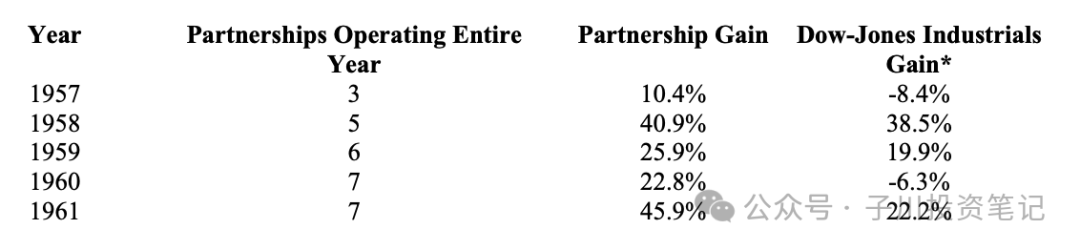
* Including dividends received through ownership of the Dow.
On a compounded basis, the cumulative results have been:
These results do not measure the gain to the limited partner, which of course, is the figure in which you are most interested. Because of the varying partnership arrangements that have existed in the past, I have used the over- all net gain (based on market values at the beginning and end of the year) to the partnership as being the fairest measure of over-all performance.
On a pro-forma basis adjusted to the division of gains entailed in our present Buffett Partnership, Ltd. agreement, the results would have been:
A Word About Par
The outstanding item of importance in my selection of partners, as well as in my subsequent relations with them, has been the determination that we use the same yardstick. If my performance is poor, I expect partners to withdraw, and indeed, I should look for a new source of investment for my own funds. If performance is good, I am assured of doing splendidly, a state of affairs to which I am sure I can adjust.
The rub, then, is in being sure that we all have the same ideas of what is good and what is poor. I believe in establishing yardsticks prior to the act; retrospectively, almost anything can be made to look good in relation to something or other.
I have continuously used the Dow-Jones Industrial Average as our measure of par. It is my feeling that three years is a very minimal test of performance, and the best test consists of a period at least that long where the terminal level of the Dow is reasonably close to the initial level.
While the Dow is not perfect (nor is anything else) as a measure of performance, it has the advantage of being widely known, has a long period of continuity, and reflects with reasonable accuracy the experience of investors generally with the market. I have no objection to any other method of measurement of general market performance being used, such as other stock market averages, leading diversified mutual stock funds, bank common trust funds, etc.
You may feel I have established an unduly short yardstick in that it perhaps appears quite simple to do better than an unmanaged index of 30 leading common stocks. Actually, this index has generally proven to be a reasonably tough competitor. Arthur Wiesenberger’s classic book on investment companies lists performance for the 15 years 1946-60, for all leading mutual funds. There is presently over $20 billion invested in mutual funds, so the experience of these funds represents, collectively, the experience of many million investors. My own belief, though the figures are not obtainable, is that portfolios of most leading investment counsel organizations and bank trust departments have achieved results similar to these mutual funds.
Wiesenberger lists 70 funds in his “Charts & Statistics” with continuous records since 1946. I have excluded 32 of these funds for various reasons since they were balanced funds (therefore not participating fully in the general market rise), specialized industry funds, etc. Of the 32 excluded because I felt a comparison would not be fair,31 did poorer than the Dow, so they were certainly not excluded to slant the conclusions below.
Of the remaining 38 mutual funds whose method of operation I felt was such as to make a comparison with the Dow reasonable, 32 did poorer than the Dow, and 6 did better. The 6 doing better at the end of 1960 had assets of about $1 billion, and the 32 doing poorer had assets of about $6-1/2 billion. None of the six that were superior beat the Dow by more than a few percentage points a year.
Below I present the year-by-year results for our period of operation (excluding 1961 for which I don't have exact data, although rough figures indicate no variance from the 1957-60 figures) for the two largest common stock open-end investment companies (mutual funds) and the two largest closed-end investment companies:
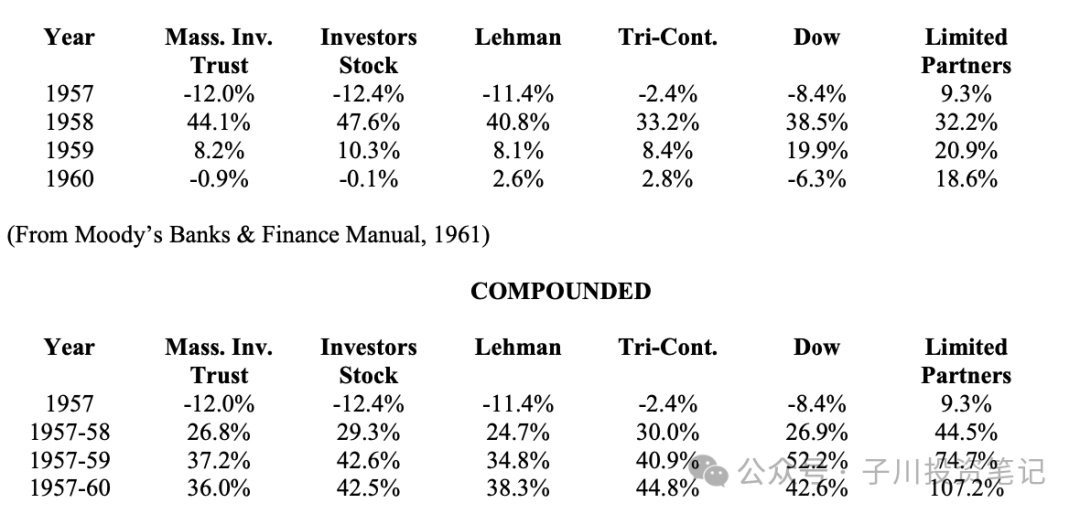
Massachusetts Investors Trust has net assets of about $1.8 billion; Investors Stock Fund about $1 billion; Tri -Continental Corporation about $ .5 billion; and Lehman Corporation about $350 million; or a total of over $3.5 billion.
I do not present the above tabulations and information with the idea of indicting investment companies. My own record of investing such huge sums of money, with restrictions on the degree of activity I might take in companies where we had investments, would be no better, if as good. I present this data to indicate the Dow as an investment competitor is no pushover, and the great bulk of investment funds in the country are going to have difficulty in bettering, or perhaps even matching, its performance.
Our portfolio is very different from that of the Dow. Our method of operation is substantially different from that of mutual funds.
However, most partners, as all alternative to their investment in the partnership, would probably have their funds invested in a media producing results comparable to the Dow, therefore, I feel it is a fair test of performance.
Our Method of Operation
Our avenues of investment break down into three categories. These categories have different behavior characteristics, and the way our money is divided among them will have an important effect on our results, relative to the Dow in any given year. The actual percentage division among categories is to some degree planned, but to a great extent, accidental, based upon availability factors.
The first section consists of generally undervalued securities (hereinafter called "generals") where we have nothing to say about corporate policies and no timetable as to when the undervaluation may correct itself. Over the years, this has been our largest category of investment, and more money has been made here than in either of the other categories. We usually have fairly large positions (5% to 10% of our total assets) in each of five or six generals, with smaller positions in another ten or fifteen.
Sometimes these work out very fast; many times they take years. It is difficult at the time of purchase to know any specific reason why they should appreciate in price. However, because of this lack of glamour or anything pending which might create immediate favorable market action, they are available at very cheap prices. A lot of value can be obtained for the price paid. This substantial excess of value creates a comfortable margin of safety in each transaction. This individual margin of safety, coupled with a diversity of commitments creates a most attractive package of safety and appreciation potential. Over the years our timing of purchases has been considerably better than our timing of sales. We do not go into these generals with the idea of getting the last nickel, but are usually quite content selling out at some intermediate level between our purchase price and what we regard as fair value to a private owner.
The generals tend to behave market-wise very much in sympathy with the Dow. Just because something is cheap does not mean it is not going to go down. During abrupt downward movements in the market, this segment may very well go down percentage-wise just as much as the Dow. Over a period of years, I believe the generals will outperform the Dow, and during sharply advancing years like 1961, this is the section of our portfolio that turns in the best results. It is, of course, also the most vulnerable in a declining market.
Our second category consists of “work-outs.” These are securities whose financial results depend on corporate action rather than supply and demand factors created by buyers and sellers of securities. In other words, they are securities with a timetable where we can predict, within reasonable error limits, when we will get how much and what might upset the applecart. Corporate events such as mergers, liquidations, reorganizations, spin-offs, etc., lead to work-outs. An important source in recent years has been sell-outs by oil producers to major integrated oil companies.
This category will produce reasonably stable earnings from year to year, to a large extent irrespective of the course of the Dow. Obviously, if we operate throughout a year with a large portion of our portfolio in work- outs, we will look extremely good if it turns out to be a declining year for the Dow or quite bad if it is a strongly advancing year. Over the years, work-outs have provided our second largest category. At any given time, we may be in ten to fifteen of these; some just beginning and others in the late stage of their development. I believe in using borrowed money to offset a portion of our work-out portfolio since there is a high degree of safety in this category in terms of both eventual results and intermediate market behavior. Results, excluding the benefits derived from the use of borrowed money, usually fall in the 10% to 20% range. My self-imposed limit regarding borrowing is 25% of partnership net worth. Oftentimes we owe no money and when we do borrow, it is only as an offset against work-outs.
The final category is "control" situations where we either control the company or take a very large position and attempt to influence policies of the company. Such operations should definitely be measured on the basis of several years. In a given year, they may produce nothing as it is usually to our advantage to have the stock be stagnant market-wise for a long period while we are acquiring it. These situations, too, have relatively little in common with the behavior of the Dow. Sometimes, of course, we buy into a general with the thought in mind that it might develop into a control situation. If the price remains low enough for a long period, this might very well happen. If it moves up before we have a substantial percentage of the company's stock, we sell at higher levels and complete a successful general operation. We are presently acquiring stock in what may turn out to be control situations several years hence.
Dempster Mill Manufacturing Company
We are presently involved in the control of Dempster Mill Manufacturing Company of Beatrice, Nebraska. Our first stock was purchased as a generally undervalued security five years ago. A block later became available, and I went on the Board about four years ago. In August 1961, we obtained majority control, which is indicative of the fact that many of our operations are not exactly of the "overnight" variety.
Presently we own 70% of the stock of Dempster with another 10% held by a few associates. With only 150 or so other stockholders, a market on the stock is virtually non-existent, and in any case, would have no meaning for a controlling block. Our own actions in such a market could drastically affect the quoted price.
Therefore, it is necessary for me to estimate the value at yearend of our controlling interest. This is of particular importance since, in effect, new partners are buying in based upon this price, and old partners are selling a portion of their interest based upon the same price. The estimated value should not be what we hope it would be worth, or what it might be worth to an eager buyer, etc., but what I would estimate our interest would bring if sold under current conditions in a reasonably short period of time. Our efforts will be devoted toward increasing this value, and we feel there are decent prospects of doing this.
Dempster is a manufacturer of farm implements and water systems with sales in 1961 of about $9 million. Operations have produced only nominal profits in relation to invested capital during recent years. This reflected a poor management situation, along with a fairly tough industry situation. Presently, consolidated net worth (book value) is about $4.5 million, or $75 per share, consolidated working capital about $50 per share, and at yearend we valued our interest at $35 per share. While I claim no oracular vision in a matter such as this, I feel this is a fair valuation to both new and old partners. Certainly, if even moderate earning power can be restored, a higher valuation will be justified, and even if it cannot, Dempster should work out at a higher figure. Our controlling interest was acquired at an average price of about $28, and this holding currently represents 21% of partnership net assets based on the $35 value.
Of course, this section of our portfolio is not going to be worth more money merely because General Motors, U.S. Steel, etc., sell higher. In a raging bull market, operations in control situations will seem like a very difficult way to make money, compared to just buying the general market. However, I am more conscious of the dangers presented at current market levels than the opportunities. Control situations, along with work-outs, provide a means of insulating a portion of our portfolio from these dangers.
The Question of Conservatism
The above description of our various areas of operation may provide some clues as to how conservatively our portfolio is invested. Many people some years back thought they were behaving in the most conservative manner by purchasing medium or long-term municipal or government bonds. This policy has produced substantial market depreciation in many cases, and most certainly has failed to maintain or increase real buying power.
Conscious, perhaps overly conscious, of inflation, many people now feel that they are behaving in a conservative manner by buying blue chip securities almost regardless of price-earnings ratios, dividend yields, etc. Without the benefit of hindsight as ill the bond example, I feel this course of action is fraught with danger. There is nothing at all conservative, in my opinion, about speculating as to just how high a multiplier a greedy and capricious public will put on earnings.
You will not be right simply because a large number of people momentarily agree with you. You will not be right simply because important people agree with you. In many quarters the simultaneous occurrence of the two above factors is enough to make a course of action meet the test of conservatism.
You will be right, over the course of many transactions, if your hypotheses are correct, your facts are correct, and your reasoning is correct. True conservatism is only possible through knowledge and reason.
I might add that in no way does the fact that our portfolio is not conventional prove that we are more conservative or less conservative than standard methods of investing. This can only be determined by examining the methods or examining the results.
I feel the most objective test as to just how conservative our manner of investing is arises through evaluation of performance in down markets. Preferably these should involve a substantial decline in the Dow. Our performance in the rather mild declines of 1957 and 1960 would confirm my hypothesis that we invest in an extremely conservative manner. I would welcome any partner’s suggesting objective tests as to conservatism to see how we stack up. We have never suffered a realized loss of more than 0.5% of 1% of total net assets, and our ratio of total dollars of realized gains to total realized losses is something like 100 to 1. Of course; this reflects the fact that on balance we have been operating in an up market. However, there have been many opportunities for loss transactions even in markets such as these (you may have found out about a few of these yourselves) so I think the above facts have some significance.
The Question of Size
Aside from the question as to what happens upon my death (which with a metaphysical twist, is a subject of keen interest to me), I am probably asked most often: "What affect is the rapid growth of partnership funds going to have upon performance?”
Larger funds tug in two directions. From the standpoint of "passive" investments, where we do not attempt by the size of our investment to influence corporate policies, larger sums hurt results. For the mutual fund or trust department investing in securities with very broad markets, the effect of large sums should be to penalize results only very slightly. Buying 10,000 shares of General Motors is only slightly more costly (on the basis of mathematical expectancy) than buying 1,000 or 100 shares.
In some of the securities in which we deal (but not all by any means) buying 10,000 shares is much more difficult than buying 100 and is sometimes impossible. Therefore, for a portion of our portfolio, larger sums are definitely disadvantageous. For a larger portion of the portfolio, I would say increased sums are only slightly disadvantageous. This category includes most of our work-outs and some generals.
However, in the case of control situations increased funds are a definite advantage. A "Sanborn Map" cannot be accomplished without the wherewithal. My definite belief is that the opportunities increase in this field as the funds increase. This is due to the sharp fall-off in competition as the ante mounts plus the important positive correlation that exists between increased size of company and lack of concentrated ownership of that company's stock.
Which is more important -- the decreasing prospects of profitability in passive investments or the increasing prospects in control investments? I can't give a definite answer to this since to a great extent it depends on the type of market in which we are operating. My present opinion is that there is no reason to think these should not be offsetting factors; if my opinion should change, you will be told. I can say, most assuredly, that our results in 1960 and 1961 would not have been better if we had been operating with the much smaller sums of 1956 and 1957.
And a Prediction
Regular readers (I may be flattering myself) will feel I have left the tracks when I start talking about predictions. This is one thing from which I have always shied away and I still do in the normal sense.
I am certainly not going to predict what general business or the stock market are going to do in the next year or two since I don't have the faintest idea.
I think you can be quite sure that over the next ten years there are going to be a few years when the general market is plus 20% or 25%, a few when it is minus on the same order, and a majority when it is in between. I haven't any notion as to the sequence in which these will occur, nor do I think it is of any great importance for the long-term investor.
Over any long period of years, I think it likely that the Dow will probably produce something like 5% to 7% per year compounded from a combination of dividends and market value gain. Despite the experience of recent years, anyone expecting substantially better than that from the general market probably faces disappointment.
Our job is to pile up yearly advantages over the performance of the Dow without worrying too much about whether the absolute results in a given year are a plus or a minus. I would consider a year in which we were down 15% and the Dow declined 25% to be much superior to a year when both the partnership and the Dow advanced 20%. I have stressed this point in talking with partners and have watched them nod their heads with varying degrees of enthusiasm. It is most important to me that you fully understand my reasoning in this regard and agree with me not only in your cerebral regions, but also down in the pit of your stomach.
For the reasons outlined in my method of operation, our best years relative to the Dow are likely to be in declining or static markets. Therefore, the advantage we seek will probably come in sharply varying amounts. There are bound to be years when we are surpassed by the Dow, but if over a long period we can average ten percentage points per year better than it, I will feel the results have been satisfactory.
Specifically, if the market should be down 35% or 40% in a year (and I feel this has a high probability of occurring one year in the next ten--no one knows which one), we should be down only 15% or 20%. If it is more or less unchanged during the year, we would hope to be up about ten percentage points. If it is up 20% or more, we would struggle to be up as much. The consequence of performance such as this over a period of years would mean that if the Dow produces a 5% to 7% per year overall gain compounded, I would hope our results might be 15% to 17% per year.
The above expectations may sound somewhat rash, and there is no question but that they may appear very much so when viewed from the vantage point of 1965 or 1970. It may turn out that I am completely wrong. However, I feel the partners are certainly entitled to know what I am thinking in this regard even though the nature of the business is such as to introduce a high probability of error in such expectations. In anyone year, the variations may be quite substantial. This happened in 1961, but fortunately the variation was on the pleasant side. They won't all be!
Miscellaneous
We are now installed in an office at 810 Kiewit Plaza with a first-class secretary, Beth Henley, and an associate with considerable experience in my type of securities, Bill Scott. My father is sharing office space with us (he also shares the expenses) and doing a brokerage business in securities. None of our brokerage is done through him so we have no "vicuna coat" situation.
Overall, I expect our overhead, excluding interest on borrowings and Nebraska Intangibles Tax, to run less than 0.5 of 1% of net assets. We should get our money's worth from this expenditure, and you are most cordially invited to drop in and see how the money is being spent.
With over 90 partners and probably 40 or so securities, you can understand that it is quite a welcome relief to me to shake loose from some of the details.
We presently have partners residing in locations from California to Vermont, and net assets at the beginning of 1962 amounted to $ 7,178,500.00. Susie and I have an interest in the partnership amounting to $1,025,000.00, and other relatives of mine have a combined interest totaling $782,600.00. The minimum for new partners last year was $25,000, but I am giving some thought to increasing it this year.
Peat, Marwick, Mitchell & Company did an excellent job of expediting the audit, providing tax figures much earlier than in the past. They assure me this performance can be continued.
Let me hear from you regarding questions you may have on any aspects of this letter, your audit, status of your partnership interest, etc. that may puzzle you.
Cordially Warren E. Buffett.
~完~

巴菲特致股东信系列文章