
子川投资笔记微信公众号:“新知”栏目,以人文视角关注AI、脑与认知、前沿科技,力图提供最新和最好的外刊文章中译、导读;“经典”栏目,持续更新“巴菲特致股东信”精译及评注系列;“维特根斯坦”哲学系列;“洞见”栏目:分享关于技术进步、AI哲学与伦理、投资哲学的深度思考。
BUFFETT PARTNERSHIP, LTD.
810 KIEWIT PLAZA
OMAHA 31, NEBRASKA
基本原则
一些合伙人坦言说(这个词很恰当),他们有时觉得很难读完我的整份年度信函。由于我似乎每年都变得更加啰嗦,我决定在开篇就强调某些基本原则。每个人都应对这些要点完全清楚。对大多数人来说这些内容可能显得过于重复,但我宁愿让十个合伙人中的九个感到略微无聊,也不愿让一个合伙人对基本概念有任何误解。
1. 合伙人的回报率绝不存在任何保证。选择每月提取0.5%的合伙人只是在做提取这个动作而已。如果我们在多年期间内的年化收益超过6%,提取额将由收益覆盖,且本金会增加。如果收益达不到6%,月度支付的部分或全部就是返还资本。
2. 任何一年如果我们未能实现至少6%的正收益,接受月度支付的合伙人在下一年将发现收到的金额会降低。
3. 当我们谈论年度盈亏时,我们指的是市场价值;也就是说,我们用年末时按市场价值计算的资产与年初相同基准的对比。这可能与该年度税后已实现收益几乎没有关系。
4. 我们做的好不好,不应该仅以当年是盈利还是亏损来衡量。而是应该与道琼斯工业平均指数、领先的投资公司等证券市场的整体表现相比较。如果我们的业绩好于这些参照标准,无论盈亏我们都认为当年做的不错。如果表现更差,我们活该挨骂。
5.虽然我更倾向于五年检验期,但即使短些,我也认为三年是判断业绩的绝对最低期限。可以肯定的是,我们会有些年份的业绩比道指差,可能还差很多。如果任何三年或更长时期业绩都很糟糕,那我们都应该开始为资金另寻出路。一个例外情况是,三年都是牛市投机泡沫期。
6.我不从事预测整体股市或商业波动的业务。如果你认为我能做到这一点,或认为这对投资计划至关重要,你就不应该加入我们的合伙企业。
7. 我不能向合伙人承诺结果。我能够确实承诺的是:
a. 我们的投资将基于价值,而不是市场热度;
b. 我们将通过充分的安全边际和投资多样化,努力将永久性资本损失(不是短期报价损失)的风险降到最低;以及
c. 我和我的妻子、孩子们将把我们几乎全部的净资产投资在合伙企业中。
1962年业绩表现
我一直告诉合伙人们,在道指下跌的年份,我们预期会表现相对出色,而在任何幅度的上涨年份,我们可能会对业绩感到惭愧。这一点在1962年得到了验证。
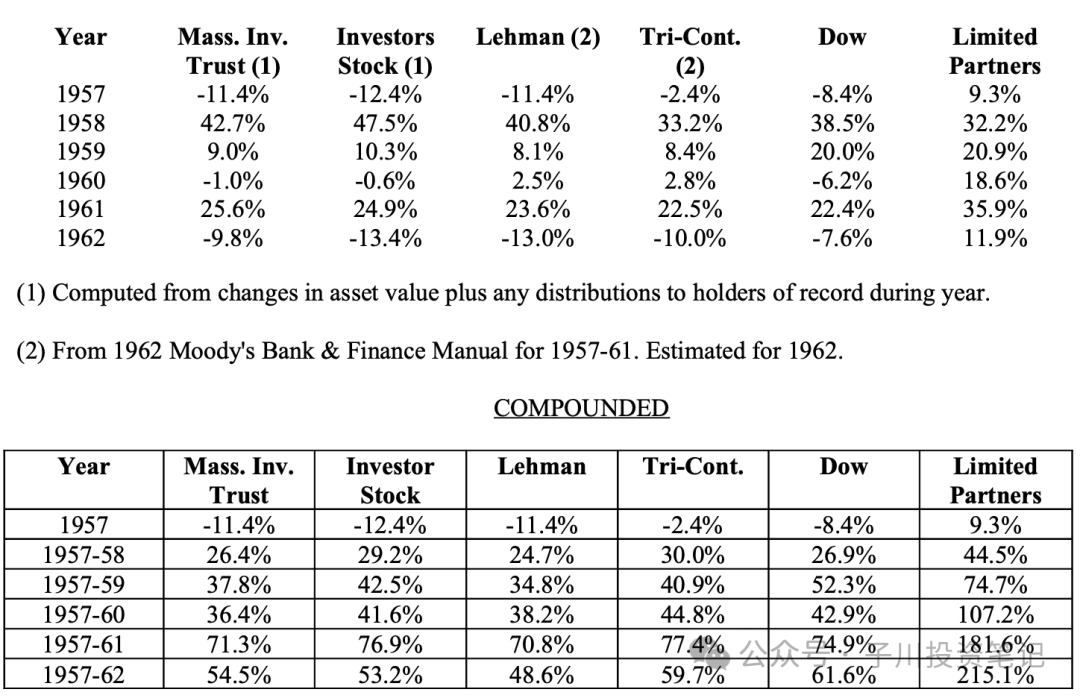
由于最后几个月大市强劲反弹,按道指衡量的整体市场实际并没有许多人想象的那么糟糕。从年初的731点,6月跌至535点、但收于652点。1960年底道指是616点,所以你可以看到,尽管过去几年有很多波动,投资大众的整体处境与1959年或1960年相比并没有太大变化。如果去年持有道指(我可以想象,一些在1961年玩热门股的人,现在希望他们去年持有道指),市值会缩水79.04点或10.8%。然而,约23.30的股息收入会使道指全年总回报率为负7.6%。我们自己的整体业绩是正13.9%。下面我们展示道指的逐年表现、合伙企业在分配给普通合伙人之前的业绩,以及巴菲特合伙有限公司及前身合伙企业的有限合伙人在所有完整年度的业绩:
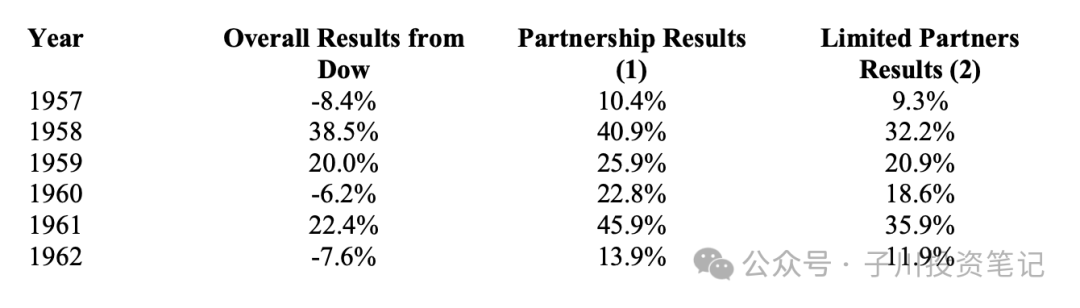
(1) 1957-61年的数据是所有前身合伙企业的合并业绩(已扣除费用,未进行分配)。
(2) 1957-61年的计算基于前一栏的合伙企业业绩,并根据现有合伙协议已向普通合伙人分配收益。
下表显示了这三个类别的累计或复合业绩,以及年均复合增长率:
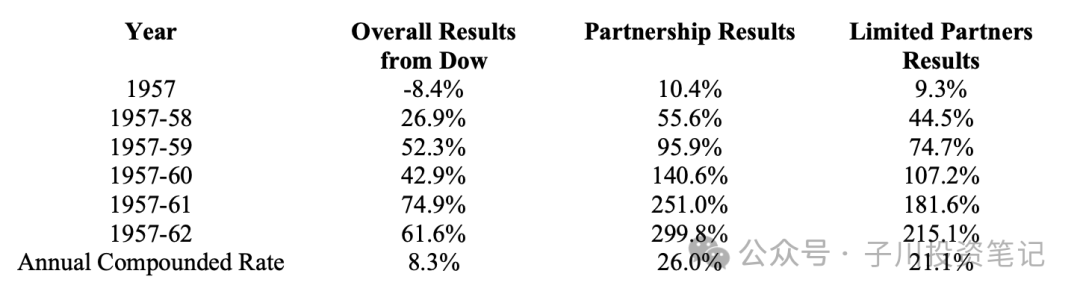
我的(非科学的)观点是,长期来看,投资资金每年超过道指十个百分点是可以实现的最大值,所以在心理上调整一下表格内数字可能比较好。
合伙人们有时会就规模对业绩的影响表示担忧。这个问题在去年的年度信函中有所反映。结论是有时会有规模效应,有时规模反倒成为阻碍,但总的来说,我不认为规模会影响业绩。我承诺如果我对此结论有任何改变会通知合伙人。在1957年初,合并的有限合伙资产总额为303,726美元,到1962年初增长到7,178,500美元。至少到目前为止,我们相对于道指的优势并没有随着资金增加而显示出收窄的趋势。
投资公司
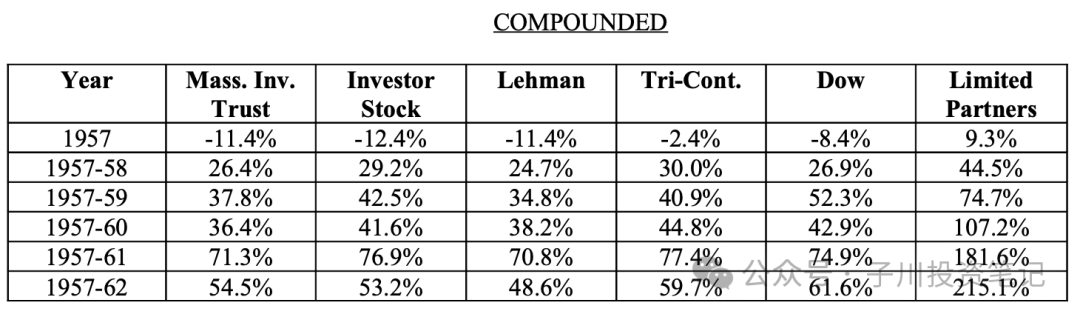
除了道指的业绩,我们一直定期列入两家最大的开放式投资公司(共同基金)和两家最大的多元化封闭式投资公司的业绩表现。这四家公司是麻省投资信托、投资者股票基金、三大洲公司和雷曼公司,共管理超过30亿美元的资产,可能代表了200亿美元投资公司行业的典型情况。我认为它们的业绩与大多数银行信托部门和投资咨询机构的业绩相似,这些机构管理的资金总额要大得多。
下面列表的目的是说明道指作为投资业绩指标很有挑战。仅管理这四家公司的投资顾问每年就收取约700万美元的费用,这只是整个行业的一小部分。然而,这些高薪人才的公众投资业绩略低于道指。这绝非批评。在他们的机构下,需要处理数十亿美元资金,我认为这样的平均业绩实际上是唯一可能的结果。他们的优势在于其他方面,而不是卓越的业绩。
我们的投资组合和运作方式与上述公司有很大不同。然而,大多数合伙人如果不投资于合伙企业,可能会将资金投资于产生与投资公司相似业绩的渠道,因此我认为它们提供了一个有意义的业绩参照。
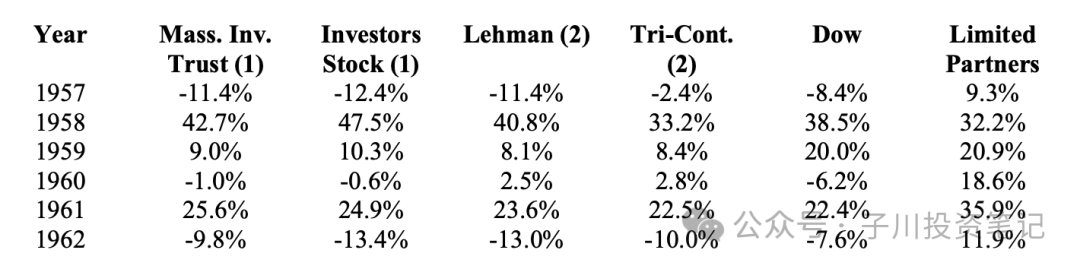
(1) 基于资产价值变动,加上当年向在册持有人的分配来计算。
(2) 1957-61年数据来自1962年穆迪银行与金融手册。1962年为估计数。

复利的乐趣
我从不太可靠的渠道得知,伊莎贝拉女王最初为哥伦布的航行承保的费用约为30,000美元。这被认为是风险投资相当成功的一次使用。不谈发现新大陆带来的精神收益,即使仅按最基本的占有权来计算,这笔交易的规模也远不止一个IBM那么简单。粗略计算,这30,000美元如果按4%年复利计算,到1962年将达到约2万亿美元(对于那些不是政府统计学家的人来说)。曼哈顿印第安人的历史辩护者们可能会从类似的计算中找到慰藉。这种奇特的几何级数说明了获得巨额财物,要么活得够长,要么以不错的利率复利增长的价值。关于前一点我没什么特别有用的建议。
(译者注:关于IBM,在1960年代市值大概200亿美金左右;关于印第安人,这可能是一个历史讽刺。传说荷兰人以24美元从印第安人手中买下了曼哈顿岛。如果把那24美元按4%年复利计算到现在,金额也会非常惊人)
下表显示了100,000美元在5%、10%和15%的利率下,经过10、20和30年的复利价值。看到相对较小的利率差异在多年后能累积成巨大差额总是令人吃惊。这就是为什么,即使我们定了很高的目标,我们也认为比道指高出几个百分点是非常有价值的成就。这在十年或二十年间可能意味着很大的金额差异。

我们的运作方法
我们的投资分为三类。这些类别有不同行为特征,我们的资金在它们之间的分配方式将对我们在任何给定年份相对于道指的业绩产生重要影响。实际的类别划分在某种程度上是计划好的,但在很大程度上是偶然的,取决于实际情况。
第一类是普遍低估的证券(以下称为"普通股"),在这类投资中我们对被投公司的政策没有发言权,也无法预测其价值低估何时会得到纠正。多年来,这一直是我们最大的投资类别,在这里赚到的钱比其他两类都多。我们通常在五六个普通股投资标的上持有相当大的仓位(每个占总资产的5%到10%),在另外十到十五个标的上持有较小仓位。
(译者注:该段内容与1961巴菲特致合伙人信-1962(1),完全一致。在下文中,完全一致的部分,将以灰色字体标记)
有时这些投资很快见效,但通常需要等上几年。在购买时很难知道它们会因为什么令人信服的具体原因而升值。然而,正是因为缺乏吸引力,也没有任何可能触发即时市场反应的因素,才能以非常便宜的价格买到这些股票。能用如此低价获得大量价值。这种实质性的超额价值为每笔交易创造了舒适的安全边际。每项独立投资的安全边际,再加上多样性投资,创造了一个在安全性和增值潜力两方面都极具吸引力的组合。我们投资这些普通股时,并不指望赚到最后一分钱,只要市场价格涨到购买价格与企业私有者估值之间的某个水平,我们就会满意地退出。
(译者注:该段内容与1961巴菲特致合伙人信-1962(1),基本一致。
1.删去了“多年来,我们的买入时机比卖出时机都要好得多。”
2.新版本用"compelling reason"(令人信服的)替代"specific reason"(具体的)
)
当我们认为控股股东群体有计划将未盈利或未充分利用的资产转化为更好的用途时,我们就以普通股投资形式介入,很多时候,这代表了一种“搭便车”。
我们自己在桑伯恩和登普斯特当过控股股东,但在其他条件相同的情况下,我们宁愿让别人来做。显然,在此情况下,不仅价值安全边际必须同样厚,我们还必须谨慎选择搭谁的便车。
我们的第二类投资是"套利"。这类证券的收益取决于被投企业的公司行为,而不是证券买卖双方创造的供需因素。换句话说,这些是有时间表的标的物,我们可以在合理误差范围内预测,什么时候能得到多少,以及什么时候计划可能被破坏。并购、清算、重组、分拆等公司事件都会带来套利机会。近年来,石油生产商向大型综合性石油公司的出售也是重要来源。
这类投资每年会产生相当稳定的收益,在很大程度上不受道指走势的影响。显然,如果我们在一年中有大部分投资组合都在套利中,当道指下跌时我们会看起来非常好,或在强势上涨年份看起来很差。
我们很幸运在1962年有相当一部分投资组合在套利中。如我之前所说,这不是因为我对市场走势有任何预见,而是因为我在这类投资中能找到比普通股更多我想要的东西。这种在套利上的集中确实在下半年市场上涨时拖累了我们的表现。
你会在我们的年末资产负债表(审计报告的一部分)上注意到总计约340,000美元的空头卖出证券。这主要发生在年底时进行的一个套利交易中。在这种情况下,我们在一段时间内几乎没有竞争,能够为几个月的资金占用创造10%或更好的利润(总额,非年化)。空头卖出消除了一般市场风险。
最后一类是"控制"型投资,我们要么控制公司,要么持有很大仓位并试图影响被投企业公司政策。这类操作肯定应该用几年时间来衡量。在某年,它们可能产生不了任何收益,因为在我们收购过程中,股价不涨通常对我们有利。这些情况与道指表现也不太相关。当然,有时我们买入普通股时就考虑到可能发展成控制型投资。如果价格在很长一段时间内保持够低,就很可能发生这种情况。我们目前正在收购一些股票,这些可能在几年后发展成控制型投资。通常,在我们获得公司大量股份之前股价上涨了,我们就在较高位置卖出,完成一次成功的普通股投资操作。
(译者注:主要变化是倒数第二句,用"Usually"替换了"If",使表述更加确定和直接。同时删除了最后一句关于当前操作的描述,这可能是为了避免时效性信息。)
登普斯特磨坊制造公司
从业绩角度来看,1962年的亮点是我们目前的控股类投资——持有登普斯特磨坊73%的股份。登普斯特主要经营农业机具(大多数零售价格在1,000美元以下)、水系统、水井供应和管道配件生产线。
这家公司过去十年的经营特点是销售停滞、库存周转率低,以及相对于投入资本几乎没有利润。
我们在1961年8月获得控制权,平均价格约为每股28美元,我们在早些年曾以低至16美元的价格买入一些股票,但绝大部分是在8月以30.25美元的要约收购中获得。当获得一家公司的控制权时,显然最重要的关注点就变成了资产的价值,而不是一张纸(股票证书)的市场报价。
(译者注:这句在实操背景下指出的关注点转变,是帮助我们理解Private Owner视角下不同判断的钥匙。)
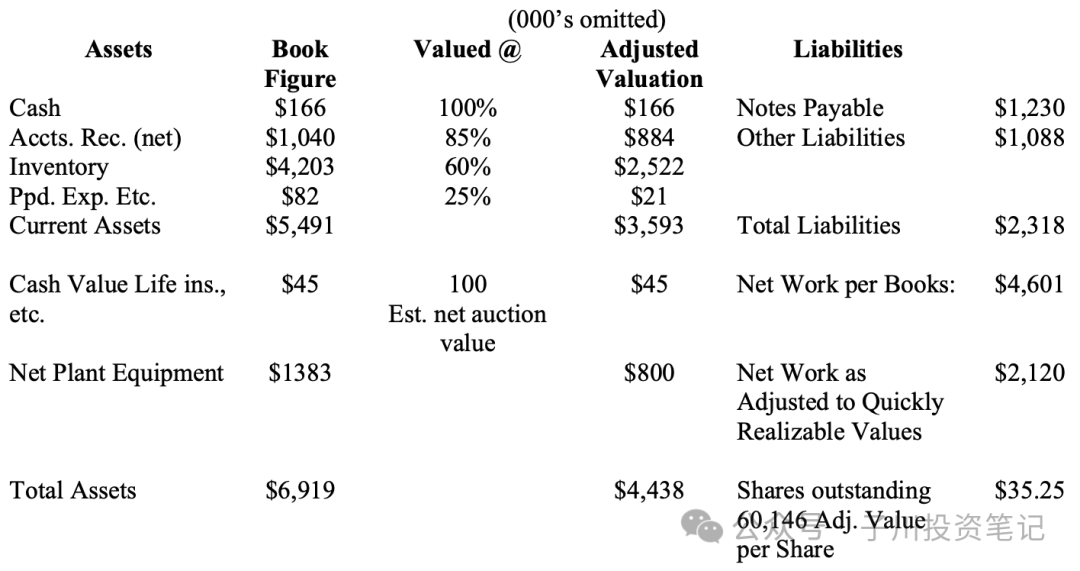
去年,我们对登普斯特的持股是通过对各类资产采用我认为适当的折扣来估值。这些估值是基于它们作为非盈利资产的状态,并不是基于潜力来评估,而是基于我认为在当时快速出售能获得的价值。我们的工作是要以适当的速度增加这些价值。去年的合并资产负债表和公允价值计算如下所示。
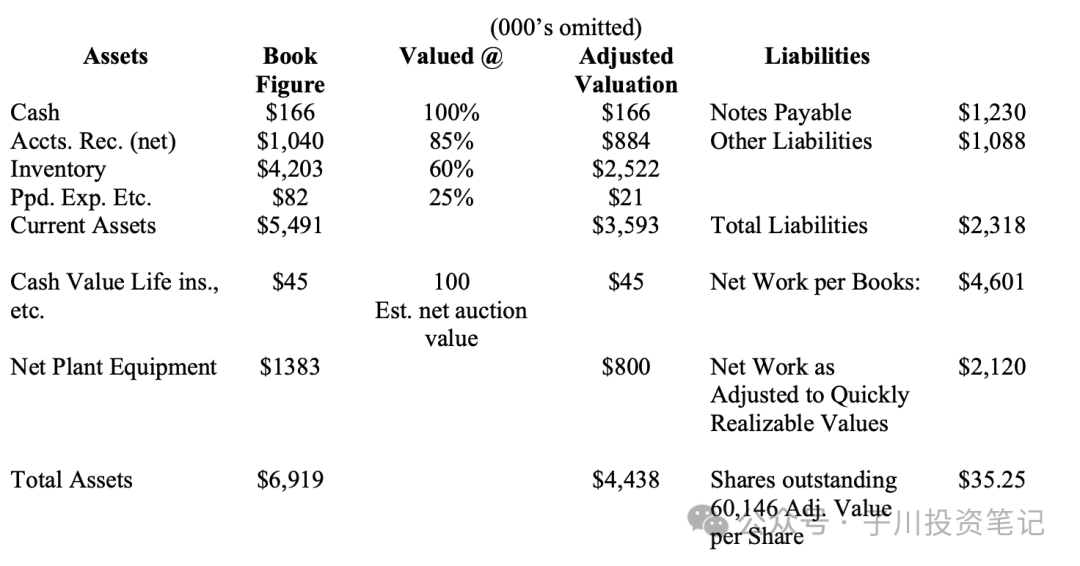
登普斯特的财年在11月30日结束,由于审计报告尚未完整可用,我去年将一些数字近似值取整到每股35美元。
最初,我们与原管理层一起努力,致力于更有效地利用资本、提高经营利润率、减少管理费用等。这些努力完全无果。大约六个月后,很明显虽然他们口头上同意我们的目标,但要么是由于无能,要么是由于不愿意,什么都没有完成。需要做出改变。
一位好朋友,他不是那种喜欢夸张描述的人,强烈推荐了哈里·博特尔来解决我们遇到的这类问题。1962年4月17日,我在洛杉矶会见了哈里,提出了一个基于实现我们目标的奖励方案,4月23日他就已经坐在比阿特丽斯(公司所在地)的总裁办公室里了。
哈里无疑是今年的功臣。我们为哈里设定的每个目标都已实现,所有意外都是惊喜。他一件接一件地完成了被认为不可能的任务,而且总是先处理最困难的事情。我们的收支平衡点已经降低了近一半,滞销或呆滞商品已被售出或注销,营销程序已经改革,非盈利设施已被出售。
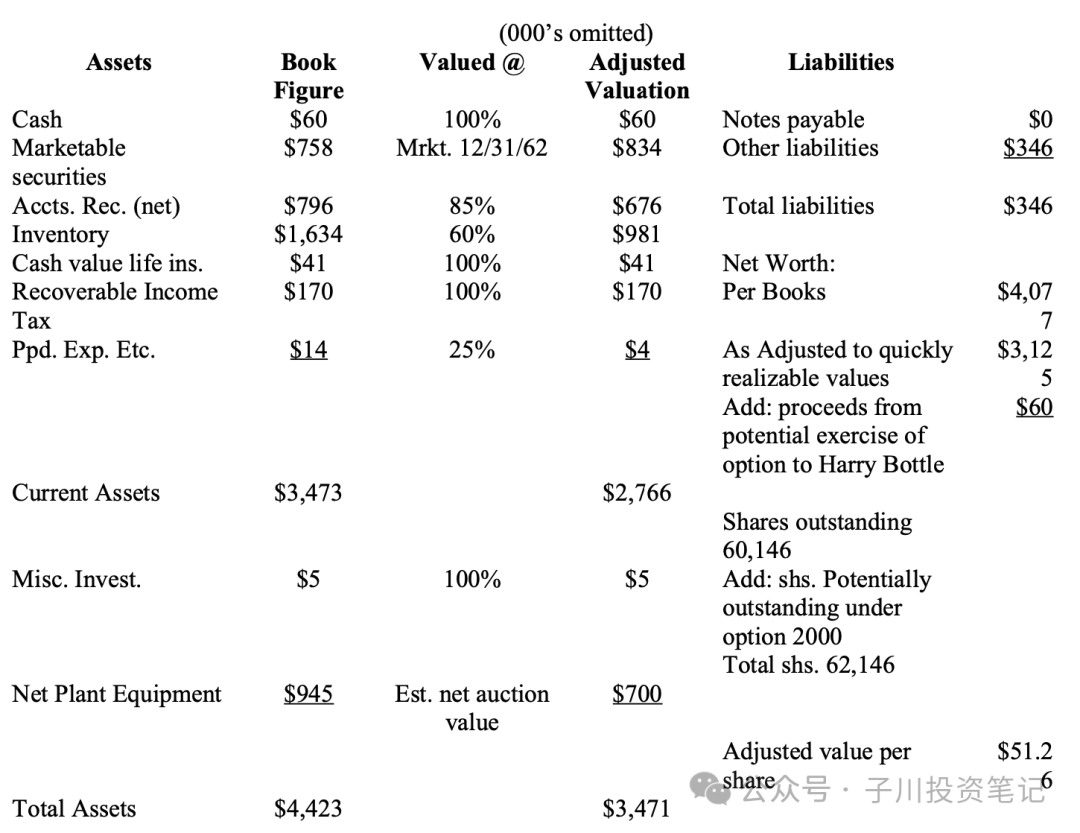
这个项目的成果部分体现在下面的资产负债表中,由于它仍然代表非盈利资产,所以采用与去年相同的估值基础。
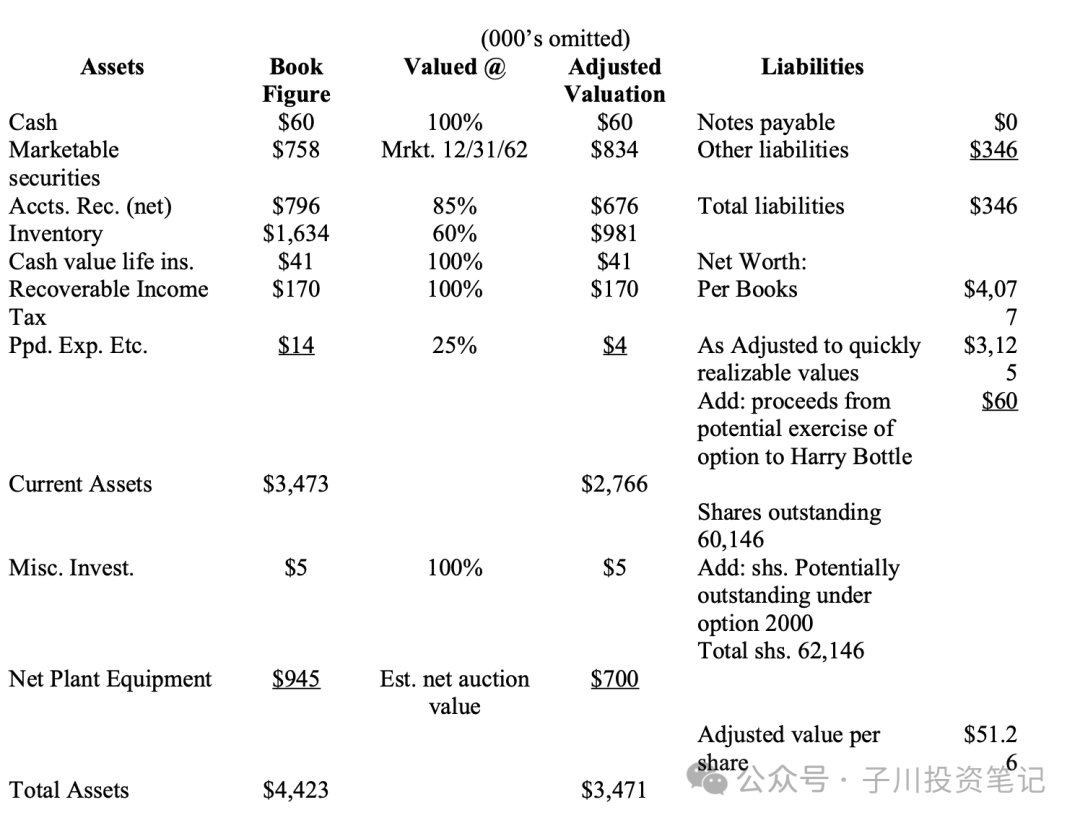
三个事实很突出:(1)尽管净资产因清理和注销而有所减少(存货注销了550,000美元;固定资产总体售价超过账面价值),我们将资产转换为现金的速度远超去年估值时的预期。(2)在某种程度上,我们已经将资产从表现不佳的制造业务转换为我们认为是好业务的证券投资。(3)通过以低价购买资产,我们不需要变魔术就能获得极好的收益率。这是我们投资理念的基石:"永远不要指望通过卖个高价来获利。要让购买价格低到即使卖个一般价格也能带来好结果。高卖只是锦上添花。"
(译者注:第三点道出了投资和商业的基本智慧。在投资领域,它强调通过低买入价格来确保安全边际,而不是寄希望于未来的高价卖出。好的投资始于买入环节的纪律,通过合理的买入价格来应对未来的不确定性,而不是靠幻想和头脑发热硬扛不确定性。
这个原则同样适用于商业经营。真正优秀的企业有实力调高定价,但不会依赖高价格获利。而是通过成本控制和效率提升,实现在平价销售时也能盈利的能力。这种模式更具可持续性,也给企业带来更强的竞争优势。)
1963年1月2日,登普斯特获得了一笔125万美元的无担保定期贷款。这些资金,连同已经"释放"的资金,将使Dempster的证券投资组合部分的价值达到每股约35美元,这远超过我们为整个公司支付的价格。因此,我们目前的估值将包括制造业务每股约16美元的净值,以及与巴菲特合伙有限公司类似的证券业务35美元。
当然,我们致力于以可观的速度增加制造业务部分的16美元,并且我们有一些好想法来实现这一目标。如果目前的业务能够盈利,这将很容易实现,即使不盈利,我们也有一些有希望的想法。
应该指出的是,去年登普斯特完全是个资产转换问题,因此既不受股票市场也不受我们在资产方面成功的影响。1963年,制造业资产仍然重要,但从估值角度来看,它的表现将更像一只普通股,因为我们将有大量资金投资于和巴菲特合伙有限公司几乎相同的普通股。出于税收原因,我们可能不会在登普斯特进行套利。因此,如果道指大幅下跌,将对登普斯特的估值产生重大影响。同样,今年登普斯特将从道指上涨中受益,而这在去年大部分时间都不会发生。
对巴菲特合伙有限公司来说,还有一个具有真正重要意义的最后一点。我们现在与一位经营者建立了关系,这可能对未来的控制情况带来巨大好处。在接手前六天,哈里从未想过要经营一家农具公司。他灵活、勤奋,一旦确定了政策就会执行到位。他喜欢凭借优秀表现赚取高薪,我喜欢和一个不想着把高管洗手间镀金的人打交道。哈里和我彼此欣赏,他与巴菲特合伙有限公司的关系应该对我们所有人都有利。
保守主义问题
因为我相信在1962年的事件之后这可能更有意义,我想重复去年信中的这一部分:
“ 以上描述或许能说明我们如何进行保守投资。几年前,许多人认为购买中长期市政债券或政府债券是最保守的投资方式。这种策略在许多情况下导致了实质性损失,也肯定不能维持或提高实际购买力。”
“很多人现在对通胀非常敏感,甚至可能敏感的过度。他们认为买入蓝筹股就是保守投资,甚至不管这些股票的市盈率、股息率等指标有多高。虽然我们还不能像回顾债券投资那样清楚地看到失败结果,但我认为盲目买入蓝筹股的方式充满危险。在我看来,去推测贪婪反复无常的大众会给予蓝筹股多高的市盈率,这种行为一点都称不上保守。”
仅仅因为一大群人暂时同意你的看法,并不意味着你是对的。仅仅因为重要人物同意你的看法,也不意味着你是对的。在许多投资圈子里,只要同时具备上述两个因素(大众认同和权威认同),就足以证明一个行动称得上保守。
如果你的假设是对的,事实是对的,推理是对的,那么经过多次交易,你就会是对的。真正的保守主义只能通过知识和理性来实现。
我要补充的是,我们的投资组合不传统,并不能证明我们的投资方式更保守或更激进。这只能通过检验方法和结果来判断。
我认为,检验我们投资方式是否保守的最客观标准,是评估在市场下跌时期的表现。最好是在道指大幅下跌时。我们在1957年和1960年那些相对温和的跌势中的表现,印证了我的假设:我们的投资方式极其保守。我欢迎任何合伙人提出关于保守性的客观测试标准,看看我们表现如何。我们从未出现超过总资产0.5%或1%的已实现损失,而且我们已实现收益与已实现损失的总额比率约为100:1。当然,这反映了我们总体上是在牛市中运作的事实。不过,即使在这样的市场中也有很多可能造成亏损的机会(你们可能自己就遇到过一些),所以我认为上述情况还是具有一定意义的。
我认为,评估我们投资方式有多保守的最客观测试来自于在下跌市场中的表现。最好是在道指出现大幅下跌的情况下。我们在1957年和1960年相对温和的市场下跌中的表现将证实我的假设,即我们以极其保守的方式进行投资。我欢迎任何合伙人提出关于保守主义的客观测试,看看我们如何衡量。我们从未遭受超过总净资产1/2的1%的已实现损失,我们已实现收益与总已实现损失的比率约为100比1。当然,这反映了我们一直在上涨市场中运作的事实。然而,即使在这样的市场中也有许多亏损交易的机会(你们可能自己就发现了其中的一些),所以我认为上述事实具有一定意义。
(译者注:此处1961年原文为0.5%of 1% of total net assets,此次更新为1/2 of 1%)
1962年,我们在一项投资上确实实现了1.0%的损失,我们的已实现收益与损失的比率仅略高于3比1。然而,与更传统的普通股投资方法(通常被称为保守,但这并不是同义词)相比,我们的方法似乎风险要小得多。我们超越道指的优势全部是在市场下跌时获得的;在上涨过程中我们失去了一些这种优势。
惯常的预测
我认为你可以非常确定,在未来十年中,会有几年整体市场上涨20%或25%,也会有几年下跌相同幅度,大多数时候在这两者之间。我不知道这些情况发生的顺序,我也不认为这对长期投资者有多大重要性。如果你把第3页的第一个表格中的年份重新排列,复合结果将保持不变。如果未来四年分别是+40%、-30%、+10%和-6%,只要我们在这四年结束时都还在,它们发生的顺序对我们的目的来说完全不重要。长期来看,我认为道指可能会产生大约每年5%的复合收益,这来自股息和市值增长的组合。尽管过去十年的经验表明,任何期望从普遍市场获得比这更好回报的人可能会失望。
我们的工作是在不过分担心某一年是盈利还是亏损的情况下,逐年累积超越道指的优势。我认为在我们下跌15%而道指下跌25%的年份,要比在合伙企业和道指都上涨20%的年份表现得更好。
基于我运营方式的原因,我们相对于道指表现最好的年份可能是在下跌或不涨不跌的市场中。因此,我们寻求的优势可能会以大幅变化的形式出现。肯定会有些年份我们被道指超越,但如果从长期来看,我们能够平均每年比它好10个百分点,我就认为业绩是令人满意的。
具体来说,如果市场在某一年下跌35%或40%(我认为这种情况在未来十年中有大概率发生一次,没人知道是哪一年),我们应该只下跌15%或20%。如果市场年内基本持平,我们希望能上涨约10个百分点。当然,要从1962年12月31日的水平上涨20%或25%是很难的。这种表现在多年期间的结果意味着,如果道指产生5%的年度整体复合收益,我希望我们的结果可能是15%每年。
上述预期可能听起来有些鲁莽,从1965年或1970年的角度来看,它们可能会显得更是如此。即使长期预期是正确的,任何给定年份的实际表现与上述描述的行为之间的差异也会很大。当然,你必须认识到这种期望中可能存在重大的个人偏见。
其他事项
今年标志着从卧室办公室过渡到一个更加(相当)传统的办公室。令人惊讶的是,回归正常工作生活并不令人不快。事实上,我很享受不用在信封背面记录所有内容。
我们今年以9,405,400.00美元的净资产开始。在1962年初,苏西和我有三项"非流通性证券"投资,规模都不小,其中两项已经售出。第三项将无限期继续持有。从这两次出售的收益中,我们增加了我们在合伙企业中的权益,现在我们的权益为1,377,400.00美元。此外,我的三个孩子、母亲、父亲、两个姐妹、两个姐夫、岳父、三个姑姑、四个表亲、五个侄子和侄女直接或间接拥有总计893,600.00美元的权益。
比尔·斯科特完美地融入了我们的运营,他(和他的妻子)拥有167,400.00美元的权益;这是他净资产的很大一部分。所以我们都把自己的真金白银押在这里。
你会从审计师的证明中注意到,他们在年内进行了突击检查,这将成为他们的程序惯例。皮特、马维克、米切尔公司再次出色地完成了审计工作,满足了我们相当紧迫的时间安排。
苏西负责布置办公室,这意味着我们没有采用我的"橙色板条箱"装修方案。我们备有充足的百事可乐,期待合伙人们来访。
贝丝·菲汉继续展示为什么她是CPS(认证专业秘书,就是这个意思)组织的顶尖高手。
合伙人们在归还协议和承诺函方面做得很好,我对此非常感激。这让生活变得容易多了。随函附上你的合伙协议附表"A"。你很快就会收到你的审计和税务数据,如果你对此有任何问题,请务必告诉我。
此致
沃伦·E·巴菲特
原文:
BUFFETT PARTNERSHIP, LTD.
810 KIEWIT PLAZA
OMAHA 31, NEBRASKA
The Ground Rules
Some partners have confessed (that's the proper word) that they sometimes find it difficult to wade through my entire annual letter. Since I seem to be getting more long-winded each year, I have decided to emphasize certain axioms on the first pages. Everyone should be entirely clear on these points. To most of you this material will seem unduly repetitious, but I would rather have nine partners out of ten mildly bored than have one out of ten with any basic misconceptions.
In no sense is any rate of return guaranteed to partners. Partners who withdraw one-half of 1% monthly are doing just that--withdrawing. If we earn more than 6% per annum over a period of years, the withdrawals will be covered by earnings and the principal will increase. If we don't earn 6%, the monthly payments are partially or wholly a return of capital.
Any year in which we fail to achieve at least a plus 6% performance will be followed by a year when partners receiving monthly payments will find those payments lowered.
Whenever we talk of yearly gains or losses, we are talking about market values; that is, how we stand with assets valued at market at yearend against how we stood on the same basis at the beginning of the year. This may bear very little relationship to the realized results for tax purposes in a given year.
Whether we do a good job or a poor job is not to be measured by whether we are plus or minus for the year. It is instead to be measured against the general experience in securities as measured by the Dow- Jones Industrial Average, leading investment companies, etc. If our record is better than that of these yardsticks, we consider it a good year whether we are plus or minus. If we do poorer, we deserve the tomatoes.
While I much prefer a five-year test, I feel three years is an absolute minimum for judging performance. It is a certainty that we will have years when the partnership performance is poorer, perhaps substantially so, than the Dow. If any three-year or longer period produces poor results, we all should start looking around for other places to have our money. An exception to the latter statement would be three years covering a speculative explosion in a bull market.
I am not in the business of predicting general stock market or business fluctuations. If you think I can do this, or think it is essential to an investment program, you should not be in the partnership.
I cannot promise results to partners. What I can and do promise is that:
an absolute minimum by obtaining a wide margin of safety in each commitment and a diversity of commitments; and
a. Our investments will be chosen on the basis of value, not popularity;
Our Performance in 1962
I have consistently told partners that we expect to shine on a relative basis during minus years for the Dow, whereas plus years of any magnitude may find us blushing. This held true in 1962.
Because of a strong rally in the last few months, the general market as measured by the Dow really did not have such a frightening decline as many might think. From 731 at the beginning of the year, it dipped to 535 in June, but closed at 652. At the end of 1960, the Dow stood at 616, so you can see that while there has been a good deal of action the past few years, the investing public as a whole is not too far from where it was in 1959 or 1960. If one had owned the Dow last year (and I imagine there are a few people playing the high flyers of 1961 who wish they had), they would have had a shrinkage in market value of 79.04 or 10.8%. However, dividends of approximately 23.30 would have been received to bring the overall results from the Dow for the year to minus 7.6%. Our own overall record was plus 13.9%. Below we show the year-by-year performance of the Dow, the partnership before allocation to the general partner, and the limited partners' results for all full years of Buffett Partnership, Ltd.'s and predecessor partnerships' activities:
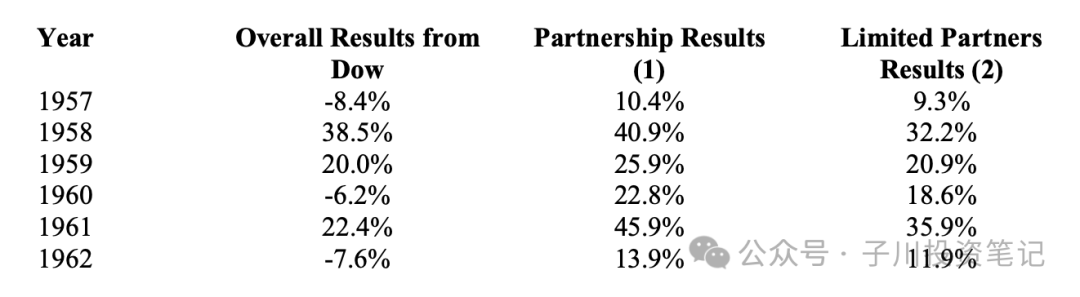
(1) For 1957-61 consists of combined results of all predecessor limited partnerships operating throughout entire year after all expenses but before distributions to partners or allocations to the general partner.
(2) For 1957-61 computed on basis of preceding column of partnership results allowing for allocation to general partner based upon present partnership agreement.
The following table shows the cumulative or compounded results in the same three categories, as well as the average annual compounded rate:
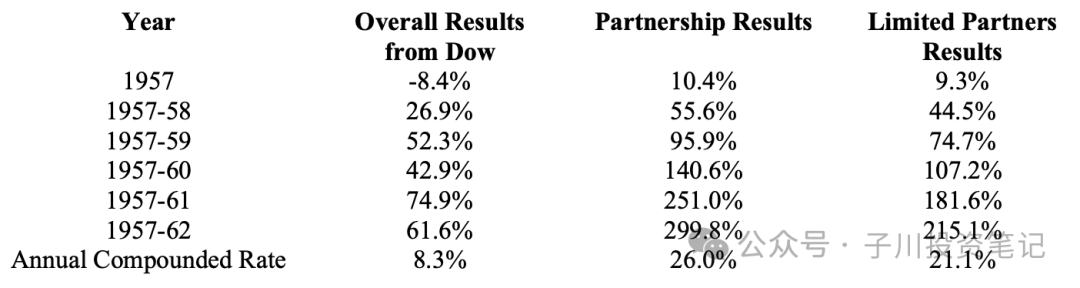
My (unscientific) opinion is that a margin of ten percentage points per annum over the Dow is the very maximum that can be achieved with invested funds over any long period of years, so it may be well to mentally modify some of the above figures.
Partners have sometimes expressed concern as to the effect of size upon performance. This subject was reflected upon in last year’s annual letter. The conclusion reached was that there were some situations where larger sums helped and some where they hindered, but on balance, I did not feel they would penalize performance. I promised to inform partners if my conclusions on this should change. At the beginning of 1957, combined limited partnership assets totaled $303,726 and grew to $7,178,500 at the beginning or 1962. To date, anyway, our margin over the Dow has indicated no tendency to narrow as funds increase.
Investment Companies
Along with the results of the Dow, we have regularly included the tabulations on the two largest open-end investment companies (mutual funds) following a common stock policy, and the two largest diversified closed- end investment companies. These four companies, Massachusetts Investors Trust, Investors Stock Fund, Tri- Continental Corp. and Lehman Corp. manage over $3 billion and are probably typical of most of the $20 billion investment company industry. My opinion is that their results parallel those of most bank trust departments and investment counseling organizations which handle, in aggregate, vastly greater sums.
The purpose of this tabulation, which is shown below, is to illustrate that the Dow is no pushover as an index of investment achievement. The advisory talent managing just the four companies shown commands annual fees of approximately $7 million and this represents a very small fraction of the industry. Nevertheless, the public batting average of this highly-paid talent indicates results slightly less favorable than the Dow. In no sense is this statement intended as criticism. Within their institutional framework and handling the many billions of dollars involved, I consider such average results virtually the only possible ones. Their merits lie in other than superior results.
Both our portfolio and method of operation differ substantially from the companies mentioned above. However, most partners, as an alternative to their interest in the partnership would probably have their funds invested in media producing results comparable with investment companies, and I, therefore feel they offer a meaningful test of performance.

The Joys of Compounding
I have it from unreliable sources that the cost of the voyage Isabella originally underwrote for Columbus was approximately $30,000. This has been considered at least a moderately successful utilization of venture capital. Without attempting to evaluate the psychic income derived from finding a new hemisphere, it must be pointed out that even had squatter's rights prevailed, the whole deal was not exactly another IBM. Figured very roughly, the $30,000 invested at 4% compounded annually would have amounted to something like $2,000,000,000,000 (that's $2 trillion for those of you who are not government statisticians) by 1962. Historical apologists for the Indians of Manhattan may find refuge in similar calculations. Such fanciful geometric progressions illustrate the value of either living a long time, or compounding your money at a decent rate. I have nothing particularly helpful to say on the former point.
The following table indicates the compounded value of $100,000 at 5%, 10% and 15% for 10, 20 and 30 years. It is always startling to see how relatively small differences in rates add up to very significant sums over a period of years. That is why, even though we are shooting for more, we feel that a few percentage points advantage over the Dow is a very worthwhile achievement. It can mean a lot of dollars over a decade or two.

Our Method of Operation
Our avenues of investment break down into three categories. These categories have different behavior characteristics, and the way our money is divided among them will have an important effect on our results, relative to the Dow, in any given year. The actual percentage division among categories is to some degree planned, but to a great extent, accidental, based upon availability factors.
The first section consists of generally undervalued securities (hereinafter called “generals”) where we have nothing to say about corporate policies and no timetable as to when the undervaluation may correct itself .Over the years, this has been our largest category of investment, and more money has been made here than in either of the other categories. We usually have fairly large positions (5% to 10% of our total assets) in each of five or six generals, with smaller positions in another ten or fifteen.
Sometimes these work out very fast; many times they take years. It is difficult at the time of purchase to know any compelling reason why they should appreciate in price. However, because of this lack of glamour or anything pending which might create immediate favorable market action, they are available at very cheap prices. A lot of value can be obtained for the price paid. This substantial excess of value creates a comfortable margin of safety in each transaction. Combining this individual margin of safety with a diversity of commitments creates a most attractive package of safety and appreciation potential. We do not go into these generals with the idea of getting the last nickel, but are usually quite content selling out at some intermediate level between our purchase price and what we regard as fair value to a private owner.
Many times generals represent a form of "coattail riding" where we feel the dominating stockholder group has plans for the conversion of unprofitable or under-utilized assets to a better use. We have done that ourselves in Sanborn and Dempster, but everything else equal we would rather let others do the work. Obviously, not only do the values have to be ample in a case like this, but we also have to be careful whose coat we are holding.
The generals tend to behave market-wise very much in sympathy with the Dow. Just because something is cheap does not mean it is not going to go down. During abrupt downward movements in the market, this segment may very well go down percentage-wise just as much as the Dow. Over a period of years, I believe the generals will outperform the Dow, and during sharply advancing years like 1961. This is the section of our portfolio that turns in the best results. It is, of course, also the most vulnerable in a declining market, and in 1962, not only did we not make any money out of our general category, but I am even doubtful if it did better than the Dow.
Our second category consists of "work-outs. These are securities whose financial results depend on corporate action rather than supply and demand factors created by buyers and sellers of securities. In other words, they are securities with a timetable where we can predict, within reasonable error limits, when we will get how much and what might upset the applecart. Corporate events such as mergers, liquidations, reorganizations, spin-offs, etc., I lead to work-outs. An important source in recent years has been sell-outs by oil producers to major integrated oil companies.
This category will produce reasonably stable earnings from year to year, to a large extent irrespective of the course of the Dow. Obviously, if we operate throughout a year with a large portion of our portfolio in work- outs, we will look extremely good if it turns out to be a declining year for the Dow, or quite bad if it is a strongly advancing year.
We were fortunate in that we had a good portion of our portfolio in work outs in 1962. As I have said before, this was not due to any notion on my part as to what the market would do, but rather because I could get more of what I wanted in this category than in the generals. This same concentration in work-outs hurt our performance during the market advance in the second half of the year.
Over the years, work-outs have provided our second largest category. At any given time, we may be in five to ten of these; some just beginning and others in the late stage of their development. I believe in using borrowed money to offset a portion of our work-out portfolio, since there is a high degree of safety in this category in terms of both eventual results and intermediate market behavior. For instance, you will note when you receive our audit report, that we paid $75,000 of interest to banks and brokers during the year. Since our borrowing was at approximately 5%, this means we had an average of $1,500,000 borrowed from such sources. Since 1962 was a down year in the market, you might think that such borrowing would hurt results. However, all of our loans were to offset work-outs, and this category turned in a good profit for the year. Results, excluding the benefits derived from the use of borrowed money, usually fall in the 10% to 20% per annum range. My self-imposed standard limit regarding borrowing is 25% of partnership net worth, although something extraordinary could result in modifying this for a limited period of time.
You will note on our yearend balance sheet (part of the audit you will receive) securities sold short totaling some $340,000. Most of this occurred in conjunction with a work-out entered into late in the year. In this case, we had very little competition for a period of time and were able to create a 10% or better profit (gross, not annualized) for a few months tie-up of money. The short sales eliminated the general market risk.
The final category is I “control” situations, where we either control the company or take a very large position and attempt to influence policies of the company. Such operations should definitely be measured on the basis of several years. In a given year, they may produce nothing as it is usually to our advantage to have the stock be stagnant market-wise for a long period while we are acquiring it. These situations, too, have relatively little in common with the behavior of the Dow. Sometimes, of course, we buy into a general with the thought in mind that it might develop into a control situation. If the price remains low enough for a long period, this might very well happen. Usually, it moves up before we have a substantial percentage of the company's stock, and we sell at higher levels and complete a successful general operation.
Dempster Mill Manufacturing Company
The high point of 1962 from a performance standpoint was our present control situation --73% owned Dempster Mill. Dempster has been primarily in farm implements (mostly items retailing for $1,000 or under), water systems, water well supplies and jobbed plumbing lines.
The operations for the past decade have been characterized by static sales, low inventory turnover and virtually no profits in relation to invested capital.
We obtained control in August, 1961 at an average price of about $28 per share, having bought some stock as low as $16 in earlier years, but the vast majority in an offer of $30.25 in August. When control of a company is obtained, obviously what then becomes all-important is the value of assets, not the market quotation for a piece of paper (stock certificate).
Last year, our Dempster holding was valued by applying what I felt were appropriate discounts to the various assets. These valuations were based on their status as non-earning assets and were not assessed on the basis of potential, but on the basis of what I thought a prompt sale would produce at that date. Our job was to compound these values at a decent rate. The consolidated balance sheet last year and the calculation of fair below.
Dempster's fiscal year ends November 30th, and because the audit was unavailable in complete form, I approximated some of the figures and rounded to $35 per share last year.
Initially, we worked with the old management toward more effective utilization of capital, better operating margins, reduction of overhead, etc. These efforts were completely fruitless. After spinning our wheels for about six months, it became obvious that while lip service was being given to our objective, either through inability or unwillingness, nothing was being accomplished. A change was necessary.
A good friend, whose inclination is not toward enthusiastic descriptions, highly recommended Harry Bottle for our type of problem. On April 17, 1962 I met Harry in Los Angeles, presented a deal which provided for rewards to him based upon our objectives being met, and on April 23rd he was sitting in the president's chair in Beatrice.
Harry is unquestionably the man of the year. Every goal we have set for Harry has been met, and all the surprises have been on the pleasant side. He has accomplished one thing after another that has been labeled as impossible, and has always taken the tough things first. Our breakeven point has been cut virtually in half, slow- moving or dead merchandise has been sold or written off, marketing procedures have been revamped, and unprofitable facilities have been sold.
The results of this program are partially shown in the balance sheet below, which, since it still represents non- earning assets, is valued on the same basis as last year.
Three facts stand out: (1) Although net worth has been reduced somewhat by the housecleaning and writedowns ($550,000 was written out of inventory; fixed assets overall brought more than book value), we have converted assets to cash at a rate far superior to that implied in our year-earlier valuation. (2) To some extent, we have converted the assets from the manufacturing business (which has been a poor business) to a business which we think is a good business --securities. (3) By buying assets at a bargain price, we don't need to pull any rabbits out of a hat to get extremely good percentage gains. This is the cornerstone of our investment philosophy: “Never count on making a good sale. Have the purchase price be so attractive that even a mediocre sale gives good results. The better sales will be the frosting on the cake.”
On January 2, 1963, Dempster received an unsecured term loan of $1,250,000. These funds, together with the funds all ready "freed-up" will enable us to have a security portfolio of about $35 per share at Dempster, or considerably more than we paid for the whole company. Thus our present valuation will involve a net of about $16 per share in the manufacturing operation and $35 in a security operation comparable to that of Buffett Partnership, Ltd.
We, of course, are devoted to compounding the $16 in manufacturing at an attractive rate and believe we have some good ideas as to how to accomplish this. While this will be easy if the business as presently conducted earns money, we have some promising ideas even if it shouldn't.
It should be pointed out that Dempster last year was 100% an asset conversion problem and therefore, completely unaffected by the stock market and tremendously affected by our success with the assets. In 1963, the manufacturing assets will still be important, but from a valuation standpoint it will behave considerably more like a general since we will have a large portion of its money invested in generals pretty much identical with those in Buffett Partnership, Ltd. For tax reasons, we will probably not put workouts in Dempster. Therefore, if the Dow should drop substantially, it would have a significant effect on the Dempster valuation. Likewise, Dempster would benefit this year from an advancing Dow which would not have been the case most of last year.
There is one final point of real significance for Buffett Partnership, Ltd. We now have a relationship with an operating man which could be of great benefit in future control situations. Harry had never thought of running an implement company six days before he took over. He is mobile, hardworking and carries out policies once they are set. He likes to get paid well for doing well, and I like dealing with someone who is not trying to figure how to get the fixtures in the executive washroom gold-plated.
Harry and I like each other, and his relationship with Buffett Partnership, Ltd. should be profitable for all of us.
The Question of Conservatism
Because I believe it may be even more meaningful after the events of 1962 I would like to repeat this section from last year’s letter:
"The above description of our various areas of operation may provide some clues as to how conservatively our portfolio is invested. Many people some years back thought they were behaving in the most conservative manner by purchasing medium or long-term municipal or government bonds. This policy has produced substantial market depreciation in many cases, and most certainly has failed to maintain or increase real buying power.
"Conscious, perhaps overly conscious, of inflation, many people now feel that they are behaving in a conservative manner by buying blue chip securities almost regardless of price-earnings ratios, dividend yields, etc. Without the benefit of hindsight as in the bond example, I feel this course of action is fraught with danger. There is nothing at all conservative, in my opinion, about speculating as to just how high a multiplier a greedy and capricious public will put on earnings.
You will not be right simply because a large number of people momentarily agree with you. You will not be right simply because important people agree with you. In many quarters the simultaneous occurrence of the two above factors is enough to make a course of action meet the test of conservatism.
“You will be right, over the course of many transactions, if your hypotheses are correct, your facts are correct, and your reasoning is correct. True conservatism is only possible through knowledge and reason.
I might add that in no way does the fact that our portfolio is not conventional prove that we are more conservative or less conservative than standard methods of investing. This can only be determined by examining the methods or examining the results.
I feel the most objective test as to just how conservative our manner of investing is arises through evaluation of performance in down markets. Preferably these should involve a substantial decline in the Dow. Our performance in the rather mild declines of 1957 and 1960 would confirm my hypothesis that we invest in an extremely conservative manner. I would welcome any partner's suggesting objective tests as to conservatism to see how we stack up. We have never suffered a realized loss of more than 1⁄2 of 1% of total net assets and our ratio of total dollars of realized gains to total realized losses is something like 100 to 1. Of course, this reflects the fact that on balance we have been operating in an up market. However there have been many opportunities for loss transactions even in markets such as these (you may have found out about a few of these yourselves) so I think the above facts have some significance.
In 1962, we did realize a loss on one commitment or 1.0% and our ratio or realized gains to losses was only slightly over 3 to 1. However, compared to more conventional (often termed conservative which is not synonymous) methods of common stock investing, it would appear that our method involved considerably less risk. Our advantage over the Dow was all achieved when the market was going down; we lost a bit of this edge on the way up.
The Usual Prediction
I am certainly not going to predict what general business or the stock market are going to do in the next year or two, since I don't have the faintest idea.
I think you can be quite sure that over the next ten years, there are going to be a few years when the general market is plus 20% or 25% a few when it is minus on the same order, and a majority when it is in between. I haven’t any notion as to the sequence in which these will occur, nor do I think it is of any great importance for the long-term investor. If you will take the first table on page 3 and shuffle the years around, the compounded result will stay the same. If the next four years are going to involve, say, a +40%, -30%, +10% and –6%, the order in which they fall is completely unimportant for our purposes as long as we all are around at the end of the four years. Over a long period of years, I think it likely that the Dow will probably produce something like 5% per year compounded from a combination of dividends and market value gain. Despite the experience of the last decade, anyone expecting substantially better than that from the general market probably faces disappointment.
Our job is to pile up yearly advantages over the performance of the Dow without worrying too much about whether the absolute results in a given year are a plus or a minus. I would consider a year in which we were down 15% and the Dow declined 25% to be much superior to a year when both the partnership and the Dow advanced 20%.
For the reasons outlined in our method of operation, our best years relative to the Dow are likely to be in declining or static markets. Therefore, the advantage we seek will probably come in sharply varying amounts. There are bound to be years when we are surpassed by the Dow, but if over a long period we can average ten percentage points per year better than it, I will feel the results have been satisfactory.
Specifically, if the market should be down 35% or 40% in a year (and I feel this has a high probability of occurring one year in the next ten --no one knows which one), we should be down only 15% or 20%. If it is more or less unchanged during the year, we would hope to be up about ten percentage points. If it is up 20% or more, we would struggle to be up as much. It is certainly doubtful we could match a 20% or 25% advance from the December 31, 1962 level. The consequence of performance such as this over a period of years would mean that if the Dow produces a 5% per year overall gain compounded, I would hope our results might be 15% per year.
The above expectations may sound somewhat rash, and there is no question but that they may appear very much so when viewed from the vantage point of 1965 or 1970. Variations in any given year from the behavior described above would be wide, even if the long-term expectation was correct. Certainly, you have to recognize the possibility of substantial personal bias in such hopes.
Miscellaneous
This year marked the transition from the office off the bedroom to one a bit (quite a bit) more conventional. Surprising as it may seem, the return to a time clock life has not been unpleasant. As a matter of fact, I enjoy not keeping track of everything on the backs of envelopes.
We are starting off this year with net assets of $9,405,400.00. At the start of 1962, Susie and I had three “non- marketable security” investments of other than nominal size, and two of these have been sold. The third will be continued indefinitely. From the proceeds of the two sales, we have added to our partnership interest so that we now have an interest of $1,377,400.00. Also, my three children, mother, father, two sisters, two brothers-in-law, father-in-law, three aunts, four cousins, five nieces and nephews have interests directly or indirectly totaling $893,600.00.
Bill Scott who has fit into our operation splendidly has an interest (with his wife) of $167,400.00; A very large portion of his net worth. So we are all eating our own cooking.
You will note from the auditor's certificate that they made a surprise check during the year and this will be a continuing part of their procedure. Peat, Marwick, Mitchell & Co. again did an excellent job on the audit, meeting our rather demanding time schedules.
Susie was in charge of equipping the office which means we did not follow my “orange crate" approach to interior decorating. We have an ample supply of Pepsi on hand and look forward to partners dropping in.
Beth Feehan continues to demonstrate why she is the high priestess of the CPS (certified professional secretary, that is) group.
Partners did a wonderful job of cooperating in the return of agreements and commitment letters, and I am most appreciative of this. It makes life a lot easier. Enclosed you will find Schedule “A” to your partnership agreement. You will be receiving your audit and tax figures very soon, and if you have questions on any of this be sure to let me hear from you.
Cordially,
Warren E. Buffett
~完~
感谢阅读,麻烦点个👍和❤️,谢谢!

1960巴菲特致合伙人信-1961(2)-手工精译及解读(本期有彩蛋)